
From choosing to waiting: where the Three sits in the suit
The card follows the decision of the Two of Wands. The choice has been made, the first steps are taken, and the work now depends partly on things outside your hands. In the suit of fire, which stands for drive and initiative, three is the number of growth beginning to show, and this is the card where that growth leaves the shore.
| Upright | Expansion, foresight, early progress, opportunity at a distance, patience |
| Reversed | Delays, blocked plans, lack of preparation, disappointment with early results |
| Element | Fire |
| Astrology | Sun in Aries, the second decan of Aries (10 to 20 degrees), called “Virtue” in Crowley’s Thoth deck (the Golden Dawn used a longer “Lord of” title) |
| Numerology | 3, the number of growth and expression (see life path number 3) |
| Yes or no | Yes, though not yet: results take time |
A view from behind: the cliff, the wands and the ships
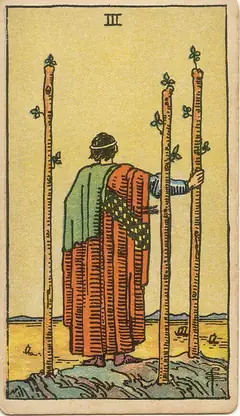
In Pamela Colman Smith’s 1909 Rider-Waite-Smith image, a man stands on a high cliff edge with his back to us. He wears a red cloak over a green tunic and holds one of three wands planted in the ground. He looks out over a calm sea where several ships sail under a yellow sky, with pale mountains on the far shore.
Because we see him from behind, we share his view instead of his expression, and that makes the card about outlook. The three wands anchor him: one in his grasp and two rooted beside him, which reads as a base he has built. The ships are his ventures, sent out across water he cannot control. They are near enough to see and far enough that he must wait.
Using the waiting time on the cliff
Upright, the Three of Wands speaks of growth that is starting to show. A business sends its first orders abroad, a proposal goes out, a long project reaches a public stage. The card praises foresight: you planned, you prepared, and now you can take a wider view.
It often suggests opportunity at a distance, such as other cities, other countries, new markets or collaborations. It also teaches patience, since the ships arrive on the tide’s schedule and not yours. The waiting time is better spent thinking about the next voyage than watching the horizon anxiously.
Distance and looking ahead together
Upright, it can describe a relationship with a wider horizon: a partner from another place or culture, plans involving travel, or a couple looking forward together. It may also fit an early stage where feelings are growing and you are comfortable waiting to see where they go.
Reversed, it can suggest distance, literal or emotional, or a plan that keeps being postponed. It invites honest conversation about timing and expectations, and it cannot say whether a relationship will last.
Expansion, overseas work and the limits of this card on money
Upright, this is a classic card for expansion: international work, a growing client base, a team that supports a project, a move from local to larger. It suits people who are planning carefully and thinking long-term.
Reversed, it can mean delays in shipping, hiring or approvals, or overstretching before foundations are solid. Tarot cannot give financial advice, so for decisions about investment or borrowing, consult a qualified professional.
Eyes on the horizon, hands on the wand
As feelings, the card describes anticipation, optimism and a steady, hopeful patience; reversed, impatience and worry that effort is not paying off. As advice, it says to keep your eyes on the horizon but your hands on the wand: stay grounded, keep planning and trust the work already done. Reversed, it advises reviewing the plan and being realistic about timing.
A question to take away: what have you already set in motion that needs time, and how can you use the waiting period well?
Cards often read beside the Three of Wands
The Four of Wands shows the celebration that can follow patience, and The Star carries a similar note of hope for the future.