By Niket JainPublished Updated Drafted with AI tools under Niket Jain's direction, checked before publishing. How we write
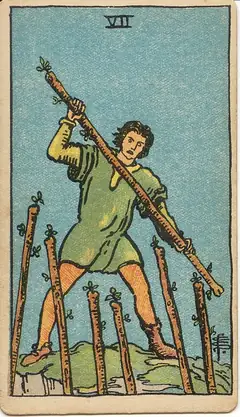
Seven of Wands in the 1909 Rider-Waite-Smith deck, drawn by Pamela Colman Smith. Public domain; scan from Wikimedia Commons.
In short
The Seven of Wands is the card of holding your ground. One man, one wand and six others pushing up at him: the image is about defending a position you believe in, and the energy that takes. Reversed, it is about the cost of that defence, either through exhaustion or through reacting to every challenge as an attack.
An unfinished victory: where the Seven sits in the Wands
In the sequence of the suit, the Seven comes straight after the win of the Six of Wands. The Six is the cheering crowd; the Seven is the less glamorous day after, when you have to keep what you won and someone is disputing it. Wands belong to fire, the element of drive and will, and the Seven shows that will being tested by opposition and not by obstacles of the terrain.
Upright
Standing your ground, defending your position, perseverance, courage under pressure
Reversed
Overwhelm, exhaustion, yielding, defensiveness, losing your footing
Element
Fire
Astrology
Mars in Leo, the third decan of Leo (20 to 30 degrees), called “Valour” in the Golden Dawn tradition
In Pamela Colman Smith’s 1909 Rider-Waite-Smith illustration, a man stands at the top of a green hillside and grips a single wand with both hands. Six more wands rise from below the edge of the hill, as if thrust up at him. He wears plain clothes and, strikingly, mismatched footwear: a boot on one foot and an ordinary shoe on the other.
The odd shoes are often read as a sign that he was caught by surprise and had no time to dress properly, yet he has still taken the high ground. The height matters, because someone defending a hilltop needs less strength than those climbing it. His face is tense and alert, but not terrified. The six wands below are not held by any visible attackers, so the opposition in your own reading could be people, circumstances or self-doubt.
When defending turns into exhaustion or a reflex
Reversed, the pressure is overwhelming. You may be tired of defending, unsure that you can hold out, or tempted to give in. Some readers also see defensiveness: treating every comment as an attack and wasting energy fighting shadows.
The kinder reading is that reversed does not mean you should collapse. It asks you to conserve energy. You may need to choose which battles matter, ask for help, or let go of a position that has cost more than it is worth. Yielding on the right point can be a strength.
Standing up for yourself in a relationship
Upright, the card can describe defending a relationship against outside criticism, holding to a boundary, or speaking up for what you need from a partner. It suits someone who needs to be assertive without being aggressive.
Reversed, it may suggest constant defensiveness in arguments, feeling outnumbered by a partner’s family, or tiredness from always having to justify your choices. It invites honest conversation and, where needed, support from friends. It cannot tell you whether a relationship should continue; that is a decision for you, and sometimes a counsellor can help.
Cards that often sit next to the Seven of Wands
The Eight of Wands follows with sudden momentum, as if the standoff breaks. Strength is the major arcana card of quiet courage, a gentler way of holding firm.
Read the full guide3 more sections: the background, the history and where it comes from
Tarot is a tool for reflection, not a proven way to predict events. This card describes a stance, not a fate, and it invites you to ask whether the hill you are defending is worth it.
Why the high ground matters more than the fight
Upright, the Seven says you are in a position worth defending and you have the ability to do it. It might be a view you hold, your work, your boundaries or your place in a team. The card commends perseverance and self-belief in the face of criticism.
It also invites perspective. The figure holds high ground, which suggests you may have more strength than the pressure makes you feel. Ask whether the challengers raise a fair point. Standing firm is admirable only when it is for something you actually value, and not just from stubbornness.
Competition, negotiation and defending your role
Upright, it fits competitive markets, tough negotiations and moments when you must justify your decisions to colleagues or clients. It praises resilience and preparation, since the person who has done the research holds the high ground.
Reversed, it may mean burnout from defending your role, a project swamped by demands, or backing down too quickly. This is not financial advice, so for disputes involving money or contracts, consult a qualified professional.
What the Seven asks you to decide
As feelings, it describes pressure, vigilance and determination, or tiredness at having to prove yourself; reversed, being overwhelmed. As advice, it says to know your reasons, hold your position calmly and not spend energy on every challenge. Reversed, it advises rest, delegation and choosing what you truly need to defend.
A question to take away: what exactly are you defending, and does it still deserve your energy? Who might help you hold the position, or help you let it go?
Frequently asked questions
↳ What does the Seven of Wands mean in a yes or no reading?
It leans towards yes, but with effort. The answer is favourable if you are willing to defend your position and keep going under pressure.
↳ Why does the man in the Seven of Wands wear mismatched shoes?
Commentators often read it as a sign that he was surprised and had no time to dress fully. It suggests that you can defend your ground even when you are not perfectly prepared.
↳ What does the Seven of Wands mean in love?
Upright, it points to standing up for your relationship or your needs. Reversed, it suggests defensiveness, exhaustion from justifying yourself or feeling outnumbered.
↳ What does the Seven of Wands mean at work?
It describes defending your position, handling competition and standing firm under criticism. Reversed, it warns of burnout and the value of choosing your battles.
↳ Which astrological sign is the Seven of Wands?
In the Golden Dawn system it is Mars in Leo, the third decan, titled Valour. Modern readers often link it with Leo or the fire element generally.