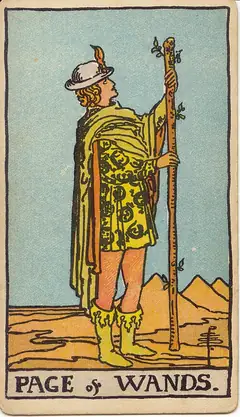
Tarot is a tool for reflection, not a proven way to predict events. Read the Page as a mood or a message. It may describe a person you know, a beginner’s attitude you are taking up, or news that invites you to try something.
The court card with the least to prove
Court cards can be read as people, as stages of mastery, or as sides of your own character. The Page is the first stage. It carries the same kind of energy as the Ace of Wands, but with a personality attached. If you want to see how that energy matures, the Knight of Wands is next.
| Upright | Curiosity, enthusiasm, a new interest, good news, a free and adventurous spirit |
| Reversed | Hesitation, scattered ideas, immaturity, enthusiasm without follow-through |
| Element | Earth of Fire (Golden Dawn court system) |
| Astrology | No single sign: in the Golden Dawn system the Pages rule a quarter of the sky rather than a stretch of the zodiac, though the card is often linked loosely with the fire signs Aries, Leo and Sagittarius |
| Numerology | A court card with no fixed number; some systems count the Page as 11, which reduces to 2 |
| Yes or no | Yes, with enthusiasm, but check the details |
In the Golden Dawn the Page of this deck corresponds to the Princess. Court card attributions vary between authors, and this site follows the Golden Dawn scheme here.
Saying yes to being an amateur
Upright, the Page of Wands describes curiosity and a willingness to try. There is an appetite for new experiences, and the person or attitude involved is open, cheerful and a little impulsive. It might be the start of a hobby, a creative experiment or a fresh interest in a place or idea.
As a message, the Page can announce good news, an invitation, or an idea that arrives suddenly. The card encourages you to explore without pressure to be good at it yet. Being a beginner is part of the deal.
Playful romance, or a spark that is not ready
In love, the upright Page brings playful, enthusiastic romance: flirting, messages, fun dates, someone eager and adventurous who may not yet be settled. It can also show a relationship rediscovering its sense of play.
Reversed, it may suggest a partner or potential partner who is not ready to commit, or who loses interest quickly. It may equally be you, holding back from a fresh start. Clear, kind conversation works better than guessing.
Learning phases, first projects and creative work
At work, the card suggests a new venture, a learning phase, an internship or a first project. It suits creative fields and any role that rewards curiosity and energy. The advice is to ask questions, try small experiments and keep learning.
Reversed, it may point to procrastination, unfinished work or plans that need firmer structure. Tarot cannot give financial advice, so use a qualified professional for any investment or money decision.
What the beginner feels, and what it suggests
As feelings, it describes excitement, eagerness and a restless wish to try something new. Reversed, it describes uncertainty, or boredom before the work has properly begun.
As advice, it says to follow your curiosity, try the thing and let yourself be an amateur. Reversed, it advises choosing a single project and committing to the first few dull steps.