By Niket JainPublished Updated Drafted with AI tools under Niket Jain's direction, checked before publishing. How we write
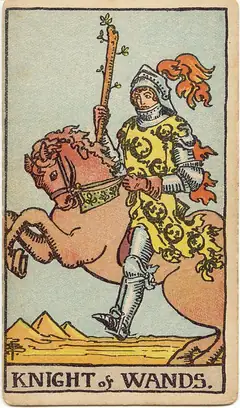
Knight of Wands in the 1909 Rider-Waite-Smith deck, drawn by Pamela Colman Smith. Public domain; scan from Wikimedia Commons.
In short
The Knight of Wands is the fire suit at full gallop, and it is the court card most defined by speed. Upright, it describes boldness, charm and momentum. Reversed, the same energy turns to haste, temper and projects dropped half done.
In Pamela Colman Smith’s 1909 Rider-Waite-Smith image, a knight in armour rides a rearing horse that charges to the side. Over his armour he wears a yellow tunic decorated with salamanders, and his helmet carries a long red and orange plume that streams behind him like flame. He holds a wand in one hand, raised as if he has just been given it.
The landscape behind him is dry and empty, so nothing slows the ride. The horse reads as instinct and drive, and it seems only loosely under control. The salamanders show his allegiance to fire. Where the Page stands still and looks, the Knight is committed to a direction.
What the energy is for
Upright, the Knight describes boldness and momentum. It can be an exciting person who sweeps through life, a trip or move made at short notice, or a phase when you feel decisive and unafraid. The card praises courage, humour and the willingness to try something large.
It asks you to point that energy at a goal that matters. The Knight needs a cause to serve, and the best version of this card commits to one. Use the speed, but look at where the horse is heading. Passion alone does not build anything, and the bare ground behind him says as much.
Careers that run on initiative and risk
At work, the Knight is a card of initiative, entrepreneurship, sales and roles that call for energy and risk-taking. It can mean a job that involves travel, or a sudden move towards a new ambition.
Reversed, it points to rushed decisions, overpromising and burnout. Tarot cannot provide financial advice, so any decision about money, especially a risky one, deserves a qualified professional.
Feelings, advice and neighbouring cards
As feelings, it describes excitement, desire, restlessness and a craving for action. Reversed, it describes impatience, irritation or tiredness after a burst of effort.
As advice, it says to act with confidence, go for the adventure and bring others along. Reversed, it advises slowing down, thinking before you leap and finishing what you start. The Queen of Wands brings the same fire with more warmth and steadiness, The Chariot also speaks of forward drive, and the Ace of Wands is where the suit begins.
Read the full guide4 more sections: the background, the history and where it comes from
Tarot is a tool for reflection, not a proven way to predict events. The Knight can describe a person, a mood in yourself or a phase of a project, and it always raises one question: is this energy carrying you towards something, or simply away from something?
Between curiosity and mastery
The curiosity of the Page of Wands has become action here, and the maturity of the King is still ahead. That in-between position explains the Knight’s character: sure of itself, fast, and not yet seasoned. Knights are the court cards in motion, each pursuing a mission, and this one pursues it with charm and a fondness for the dramatic gesture.
Often linked with Sagittarius, though court card attributions vary between authors
Numerology
A court card with no fixed number; some systems count the Knight as 12, which reduces to 3
Yes or no
Yes, quickly, but watch for haste
Court card astrology is the least settled part of tarot, so read the Sagittarius link as one tradition among several.
Reined in, or run into the ground
Reversed, the energy runs out of control or turns in on itself. Impulsiveness, losing your temper, promising more than you can deliver and leaving projects half done are all common readings. It may also describe burnout after rushing, or frustration when nothing moves as fast as you want.
A kinder interpretation is that the horse needs to be reined in, not shot. Pausing, planning and finishing one thing before starting the next can turn the same passion into results. If the Knight describes someone else, it may be a person who is exciting but inconsistent, so judge by their actions over time.
Sparks, grand gestures and cooling off
In love, the upright Knight is a passionate, charming and adventurous romantic. It describes quick attraction, grand gestures and relationships that feel alive. It may also show a couple who travel or try new things together.
Reversed, it may suggest a whirlwind that cools, a partner who blows hot and cold, or restlessness in yourself. It is not a verdict on any relationship. It asks you to notice whether intensity is being matched by reliability.
Riding towards, riding away
What are you riding towards, and what are you riding away from? What would it mean to finish one thing before the next adventure?
Frequently asked questions
↳ What does the Knight of Wands mean in a yes or no reading?
It leans towards yes and suggests fast progress. The warning is about haste, so check the details before you leap.
↳ What does the Knight of Wands mean in love?
Upright, it points to passion, charm and adventure. Reversed, it can mean a fleeting spark, mixed signals or restlessness that needs honest conversation.
↳ Is the Knight of Wands a good card?
Generally yes, as it stands for energy, confidence and courage. Its shadow side is impulsiveness and lack of follow-through, which is what the reversed card highlights.
↳ What does the Knight of Wands mean as a person?
Often someone energetic, charming and adventurous, who loves new experiences. They may also be restless, so their actions over time show more than their enthusiasm.
↳ Which zodiac sign is the Knight of Wands?
He is often linked with Sagittarius, but court card attributions differ between authors, so there is no single agreed answer.