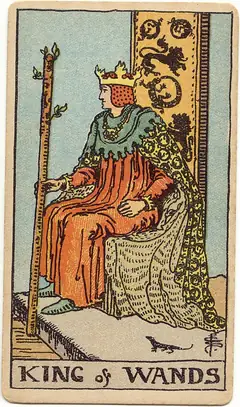
King of Wands, the card as Pamela Colman Smith drew it for the 1909 Rider-Waite-Smith deck
King of Wands in the 1909 Rider-Waite-Smith deck, drawn by Pamela Colman Smith. Public domain; scan from Wikimedia Commons.
In short

The King of Wands is the fire suit at its most mature: passion that has learned to aim. Upright, he stands for leadership built on vision and conviction, the person who sets a direction and takes responsibility for it. Reversed, the same strengths tip into domination, impulsiveness and plans that ignore practical limits.

A throne of lions and salamanders

In Pamela Colman Smith’s 1909 Rider-Waite-Smith drawing, the King sits on a throne decorated with lions and salamanders, leaning a little forward with a wand in one hand. The wand still carries fresh green leaves, as the Ace’s does. He wears a crown shaped like flames and a flowing cloak patterned with salamanders. A small salamander sits at his feet.

The living wand is the detail to notice: his authority is still growing, not fixed. The lions suggest courage and pride, and the salamanders, the legendary creatures of fire, mark him as ruler of the element itself. His head is turned to the side, as if he is watching something ahead. He seems a leader who has sat down only because the next decision needs him.

Where the suit’s story has been heading

Within the court, the Page of Wands is curious and the Knight is hasty. The King has turned that same energy into purpose. The spark of the Ace of Wands is still recognisable in his green wand, but it now has a throne under it.

UprightVisionary leadership, courage, charisma, inspiration, taking responsibility
ReversedDomineering, impulsive, ruthless ambition, unrealistic goals, ego
ElementFire
AstrologyOften linked with Leo, though court card attributions vary a good deal between authors
NumerologyA court card with no fixed number; some systems count the King as 14, which reduces to 5
Yes or noYes, if you can lead it responsibly

Court card astrology is the least settled part of tarot, so treat the Leo link as one tradition among several and not as a rule.

When the vision turns into control

Reversed, the strengths tip into excess. Vision becomes stubbornness, confidence becomes domination and courage becomes recklessness. The King may demand too much of others, act on impulse or chase a grand plan with no regard for the practicalities.

A gentler reading is that the energy is blocked: a leader who feels uncertain or has lost direction. Whether the reversal points at someone else or at you, the usual step is to listen, consult and ground the vision in realistic detail.

A partner with big plans

In love, the upright King is passionate, protective and generous. He may describe someone confident, loyal and decisive, or a relationship in which both people share a vision for the future.

Reversed, it may suggest controlling behaviour, pride or a partner who does not listen. It is a prompt to check that power in the relationship is shared and that each person feels heard. It is not a reason, by itself, to stay or to leave anything.

Feelings, advice and the card beside him

As feelings, the card describes confidence, ambition, pride and a sense of responsibility. Reversed, it describes frustration at not being in control, or a need to dominate.

As advice, it says to lead with purpose, communicate your vision and take responsibility. Reversed, it advises humility, listening and testing your plans against reality. The Queen of Wands sits beside him in the suit, and The Emperor is the major arcana card of structure and authority.

Read the full guide3 more sections: the background, the history and where it comes from

Tarot is a tool for reflection, not a proven way to predict events. Court cards can describe people, but they are more useful as qualities you can develop, so you can ask what the King of Wands would do in your situation, whatever your own role.

Leading by conviction, not by force

Upright, the King of Wands describes leadership grounded in vision and confidence. He sets a direction and inspires others to follow it through conviction and example. He is bold and honourable, and willing to take risks, yet experience has taught him to back them with planning.

The card can stand for a mentor, a boss, an entrepreneur or your own capacity to lead. It asks you to decide what you are working towards, say it plainly and take ownership of the result. Charisma works best when it serves something bigger than the ego.

Founders, managers and anyone setting direction

At work, this is a strong card for business and leadership: founders, managers and anyone who has to set direction and bring a team along. It favours boldness that is backed by a plan.

Reversed, it may indicate an overbearing boss, unrealistic targets or an entrepreneur taking too many risks. Tarot cannot give financial advice, so take any serious money or business decision to a qualified professional.

What are you trying to lead?

At work, at home or in your own life, what vision would make others want to follow? Where might your strength be turning into control?

Frequently asked questions

↳ What does the King of Wands mean in a yes or no reading?

It leans towards yes, particularly when the question involves leadership, ambition or taking initiative. It is most positive when you can take responsibility for the result.

↳ What does the King of Wands mean in love?

Upright, it points to a confident, protective and generous partner with a clear vision for the future. Reversed, it suggests domineering behaviour or pride, and a need to listen.

↳ What does the King of Wands mean at work?

It describes strong, visionary leadership and is a good sign for founders, managers and anyone setting direction. Reversed, it warns of overbearing behaviour or unrealistic goals.

↳ What do the salamanders on the King of Wands mean?

The salamander is the legendary creature that lives in fire. Its repeated appearance on the throne and cloak marks the King as master of the fire element.

↳ Which zodiac sign is the King of Wands?

He is often linked with Leo, but court card attributions differ between authors, so there is no single agreed answer.