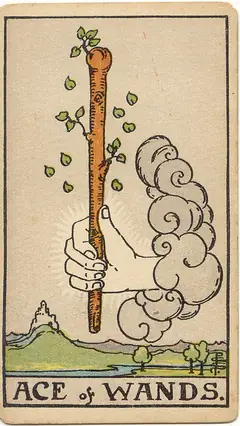

A hand from the cloud holding a living staff
In the Rider-Waite-Smith deck, drawn by Pamela Colman Smith in 1909, a hand emerges from a cloud and grips a thick wooden staff that is already sprouting green leaves. The hand is offered, not forced on anyone: the gift comes from outside the picture, and you decide whether to grasp it.
Small yellow leaves float down from the wand, and they are often described as yod shapes, after the Hebrew letter that stands for the hand and the beginning of things. Below, a green valley with a winding river runs towards a castle on a distant hill, with pale mountains on the horizon. The castle can be read as the goal or settled life waiting to be built. The budding wand suggests this fire is fertile rather than destructive: a dry stick that still sprouts.
Ace of Wands at a glance: the root of the fire suit
| Upright | Inspiration, a new idea, creative spark, enthusiasm, a bold start |
| Reversed | Delays, false starts, lack of direction, energy that will not catch |
| Element | Fire |
| Astrology | The fire signs as a group: Aries, Leo and Sagittarius |
| Numerology | 1, the number of beginnings (see life path number 1) |
| Yes or no | Yes, with energy behind it |
In the Golden Dawn system the four Aces are the roots of the elements and are not tied to a single sign, which is why the astrology row names the whole fire element.
Switched on: what the upright Ace asks of you
Upright, the Ace of Wands is the feeling of being switched on. An idea arrives fully charged and you want to act on it today. It can point to a creative project, a business idea, a move, a new fitness routine, or simply a renewed appetite for life after a flat stretch.
The card values courage and initiative over perfect planning, and says the first step matters more than a flawless map. The practical caution is that a spark burns out quickly unless it is fed. The rest of the suit, from the Two of Wands onward, tells the story of what happens when it is.
A spark that will not catch: the reversed Ace
Reversed, the energy is present but blocked or turned inward. You may have ideas and no momentum, or a burst of motivation that disappears before anything is done. Some readers see a project delayed by timing, tiredness or other people rather than a failure.
A gentle reading is to ask what is smothering the fire. Often it is exhaustion, fear of doing the thing badly, or too many sparks at once. Reversed does not mean the idea is dead. It may need rest, a clearer purpose or a smaller first step.
Chemistry, courage and a spark that needs feeding: love
Upright, the Ace of Wands often describes chemistry: a new attraction, renewed passion in a long relationship, or the courage to say what you feel. It favours playfulness and spontaneity. For a couple it can mean starting something together, such as a trip or a shared project.
Reversed, it can suggest flirtation that goes nowhere, mismatched timing, or passion that has cooled through neglect. It is not a verdict on anyone, and it never says whether to stay or go. It invites you to notice whether the spark is being fed, and to have an honest conversation if it is not.
Launches, side projects and the first small test: work and money
Upright, this is the card of a fresh idea, a new role, a launch or a burst of productivity. It suits makers and anyone asking whether to begin. Take it as encouragement to start small and test the idea, not as a signal to stake everything on it.
Reversed, it points to stalled plans, procrastination or an idea that has not been thought through. Consider what needs clarifying before you commit time or money. Tarot cannot give financial advice, so use proper professional guidance for any money decision.