By Niket JainPublished Updated Drafted with AI tools under Niket Jain's direction, checked before publishing. How we write
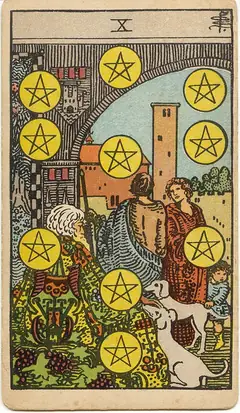
Ten of Pentacles in the 1909 Rider-Waite-Smith deck, drawn by Pamela Colman Smith. Public domain; scan from Wikimedia Commons.
In short
The Ten of Pentacles completes the suit and widens the view from one person to three generations, an old home and a legacy. It is the card of what is shared and handed down: belonging, family, tradition and being part of something that will outlast you.
In the Rider-Waite-Smith deck (Pamela Colman Smith, 1909), an elderly man with a long beard sits in the foreground in a robe covered in grapes and other symbols, with two dogs beside him. Under a stone archway, a man and a woman stand together, and a child stands close to them. Behind is a large castle or estate. Ten pentacles are arranged across the scene in the pattern of the Kabbalistic Tree of Life.
The old man is the elder who gathered the wealth and the family. The dogs, one of which greets him, are traditionally faithful, domestic animals and stand for loyalty. The couple and the child are the next generations, standing close and not looking at him, so the household seems to carry on without needing him at the centre. The grapes on his robe recall the vineyard of the Nine of Pentacles: her private harvest has become a family’s inheritance.
Legacy in the broad sense, upright
Upright, the Ten points to lasting security and belonging. It often refers to family, home, and inheritance in a broad sense, including traditions, skills and values as well as property.
It is a deeply stabilising card. The advice is to value continuity, to think about what you want to pass on and to tend the relationships that make a place feel like home. Not everyone has an easy family, and the card can equally describe a chosen family or a community that gives you roots.
Commitment with a long horizon in love
Upright, the Ten in love speaks of commitment with a long horizon: marriage, children, shared property or a household built to last. It suggests a relationship that is comfortable among family and friends and has a sense of shared history. For someone who is single, it can point to a wish for that sort of rootedness.
Reversed, it may suggest tension with relatives, differing ideas about the future, or pressure to follow a set path. A constructive reading is to talk about what each of you truly wants from home and family, without assuming one model fits everyone. If family conflict is weighing on you, a counsellor or mediator can help in ways a card cannot.
Feelings, advice and a question about what you will hand on
As feelings, the card suggests contentment, belonging and a sense of continuity, or in reverse a worry that the ground is less firm than it should be. As advice, it says: think beyond the short term, honour the people and traditions that support you, and build something that can outlast your own effort. Reversed, the advice is to address the cracks while they are small, and to decide which inherited habits you wish to keep.
A question to reflect on: what would you most like to hand on to the people who come after you, whether or not they are related to you? Where in your life do you feel most at home, and what keeps it that way?
Read the full guide5 more sections: the background, the history and where it comes from
Tarot is a tool for reflection and not a proven way to predict events, so the card does not tell you that wealth or family harmony will arrive. It asks what you are part of, and what you might leave for others.
Ten of Pentacles in a table: Mercury in Virgo and the number 10
Upright
Legacy, family, belonging, lasting security
Reversed
Family friction, instability, fragile foundations, pressure to conform
Element
Earth
Astrology
Mercury in Virgo (the third decan of Virgo, Golden Dawn)
Numerology
10, which reduces to 1: a cycle complete and a new one about to start
Yes or no
Yes
The Golden Dawn assigns this card Mercury in Virgo (Crowley’s Thoth deck titles it “Wealth”). Mercury, the planet of communication and exchange, in the careful sign of Virgo suggests prosperity that is managed, recorded and passed on with thought. Numerologically, 1 + 0 = 1, so the end of one cycle carries the seed of the next, a point that connects back to the Ace of Pentacles. See life path number 1 for that number.
Why the coins follow the Tree of Life
The layout of the ten coins matches the ten sephiroth of the Kabbalistic Tree of Life, which the Golden Dawn and later tarot designers used. It is usually read as linking everyday wealth to a larger spiritual order, as though the ordinary world were also an expression of something greater.
The Ten beside the Emperor and the World
The Emperor is structure imposed by one will; the Ten is structure built up slowly by a household over time. The World is the Major Arcana’s image of completion, and the Ten is the same idea at the scale of one family and one suit.
The Ten of Cups is the emotional counterpart. The Ten of Cups gives the happiness of the family, and the Ten of Pentacles gives its house, its land and its habits.
When the foundations feel less sure
Reversed, the Ten suggests foundations that feel less firm. Common readings include family disagreements, pressures about money or property, feeling stifled by tradition, feeling you do not belong, or a plan that depends on a structure that is not as stable as it appears.
It is not a prophecy of loss. A reversed Ten is usually an invitation to look at what holds the group together and what is straining it, and to have the conversations that have been postponed. It can also be freeing, since some people need to loosen inherited expectations in order to build their own life.
Family firms, property and long-term work
Upright, the card often refers to a well-established business or career, a family firm, a long-term investment of effort or a secure position. It speaks to stability over years, not to instant gains. It describes a theme and is not financial advice or a forecast.
Reversed, it can indicate disputes over money or property, family business tension, or a situation built on insecure ground. Practical steps include having agreements in writing and, for inheritance, property or legal questions, consulting a qualified professional. The card is a prompt to think, never a guide for legal or financial action.
Frequently asked questions
↳ What does the Ten of Pentacles mean in a yes or no reading?
It is one of the strongest yes cards in the suit, especially for questions about family, home and long-term stability. It reflects a tendency and does not guarantee a result.
↳ Does the Ten of Pentacles mean I will be rich?
Not necessarily. The card is about lasting security, family and legacy, which can include money but is not confined to it. Tarot is for reflection and not for predicting your finances.
↳ What does the Ten of Pentacles mean in love?
Commitment with a long horizon, such as family, marriage or a shared home. Reversed, it can mean family tension or differing visions of the future.
↳ What does the Ten of Pentacles reversed mean?
Often family friction, unstable foundations or pressure from tradition. It is an invitation to address concerns and to decide which expectations are really yours.
↳ Why are the pentacles arranged like the Tree of Life?
The ten coins follow the pattern of the ten sephiroth in Kabbalistic tradition, which the Golden Dawn and later tarot designers used. It is usually read as linking everyday wealth to a larger spiritual order.