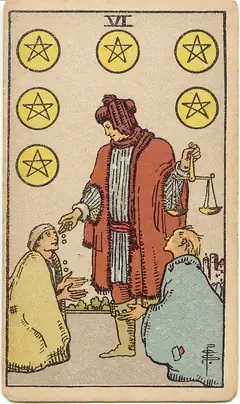
Six of Pentacles, the card as Pamela Colman Smith drew it for the 1909 Rider-Waite-Smith deck
Six of Pentacles in the 1909 Rider-Waite-Smith deck, drawn by Pamela Colman Smith. Public domain; scan from Wikimedia Commons.
In short

The Six of Pentacles is the card of giving and receiving, and the only one in the suit that puts both on the same table. After the hardship of the Five, resources begin to move again, and the card asks who holds them, who needs them and on what terms they change hands. It is as much about how it feels to be on either side of the exchange as about generosity.

A rich man, a pair of scales and two kneeling figures

In the Rider-Waite-Smith deck (Pamela Colman Smith, 1909), a well-dressed man in a rich robe stands in the centre. He holds a pair of scales in one hand and with the other drops coins into the open hand of one of two kneeling figures in worn clothes. Above them hang six pentacles, in two groups.

The scales point to measurement and fairness: someone has judged what is to be given. The standing figure is tall and the kneeling ones are low, so the card makes the imbalance of power visible and leaves you to decide how you feel about it. Is this kind charity, or control dressed as kindness? Different readers identify with different figures, and the card works whichever one you see yourself as.

When giving comes with a price tag

Reversed, the flow is blocked or distorted. Typical readings include giving that comes with conditions, help that leaves the receiver feeling indebted, a one-sided arrangement where one person always gives, or a reluctance to share at all.

It can also turn inward: giving more than you can afford, or finding it hard to accept anything without feeling you must repay it immediately. The gentle reading is to look at balance. Is there something you give without being asked, or receive with a cost you had not agreed to? Naming the terms aloud often clears much of the tension.

Keeping the ledger out of the relationship

Upright, the Six in love suggests a relationship with a sense of fairness, where each person gives and receives, and practical support such as cooking or caring is noticed and appreciated. It may also describe a time when one partner supports the other through a difficult period, freely and without scorekeeping.

Reversed, it can point to an unequal relationship, where one person holds the power by giving or withholding, or where generosity is used as leverage. A careful and kind response is to talk honestly about what each of you needs and expects, without turning it into a ledger. If the imbalance feels hard to name, a counsellor can help; the card cannot tell you whether to stay.

Fair pay, loans and favours at work

Upright, the card can describe fair pay, a mentor sharing knowledge, charitable giving, or a fair division of costs. It can also speak of receiving support during a tight period. This describes themes and is neither a prediction of income nor financial advice.

Reversed, it may describe unfair pay, a lopsided workload, money owed, loans with heavy conditions or a manager who uses favours as control. Good practice is to get agreements in writing and, for any significant debt or lending, to consult a qualified professional. At work, it can also simply ask you to notice who does the giving in your team.

Feelings, advice and a question about your own flow

As feelings, the card suggests gratitude, a sense of fairness or of being cared for, or else being in someone’s debt. Reversed, it might be resentment about an unbalanced arrangement. As advice, it says: give what you can freely, receive what you need without shame, and keep the terms clear. Reversed, the advice is to check the balance and say what you need before resentment builds.

A question to reflect on: in which part of your life are you doing most of the giving, and in which are you mostly receiving? Is either one difficult for you to do gracefully?

Read the full guide3 more sections: the background, the history and where it comes from

Tarot is a tool for reflection and not a proven way to predict events, so this card does not promise a windfall. It invites you to look at the flow of support in your own life.

Six of Pentacles in a table: Moon in Taurus

UprightGenerosity, fair exchange, help given or received, sharing
ReversedStrings attached, unequal giving, debt, dependence or stinginess
ElementEarth
AstrologyMoon in Taurus (the second decan of Taurus, Golden Dawn)
Numerology6: harmony, responsibility, care, reciprocity
Yes or noYes, when the exchange is fair

The Golden Dawn pairs this card with the Moon in Taurus (Crowley’s Thoth deck titles it “Success”): the changing, caring Moon in the steady sign of resources. The link to nurture and material support fits the picture well. For the number’s wider associations with care and responsibility, see life path number 6.

Help that arrives on fair terms

Upright, the Six describes generosity and help moving in the right direction. It might be you giving your time, money, knowledge or patience, or you receiving support that you need and can accept with grace. Fair pay, shared resources, mentoring, a loan made on clear terms and a good-natured favour could all belong to it.

It also carries a note about proportion. Good giving pays attention to what the other person actually needs, and good receiving allows you to accept without shame. A healthy life has both movements in it.

What follows the Five, and who else holds scales

The Five of Pentacles shows two figures struggling through snow, shut out from the warmth, and the Six is what help can look like when it arrives. In the Major Arcana, Justice also holds scales, but her scales weigh right and wrong, while these weigh a portion of money. The Six is about fairness between neighbours, not about a verdict.

The Six of Cups offers a gentler, more childlike kind of giving, with flowers and memory in place of coins and a ledger.

Frequently asked questions

↳ Does the Six of Pentacles mean money is coming to me?

Not as a prediction. It is usually read as support being offered or exchanged, such as fair pay, a gift or a favour. Tarot is for reflection, so treat it as a prompt to think about what you give and receive.

↳ Am I the giver or the receiver in the Six of Pentacles?

It can be either, and the surrounding cards and your question usually indicate which. Many readers find it helpful to imagine yourself in both positions.

↳ What does the Six of Pentacles mean in a yes or no reading?

It leans towards yes when the arrangement is fair and mutual. If the exchange feels one-sided or conditional, the answer may become a qualified maybe.

↳ What does the Six of Pentacles reversed mean?

Often strings attached, uneven giving or unwelcome dependence. It can also refer to reluctance to give or to accept help. The card invites you to restore balance.

↳ What does the Six of Pentacles mean in love?

Upright, a relationship with fair give and take and practical care. Reversed, an unequal arrangement where generosity is used to control or where one person feels they are carrying everything.