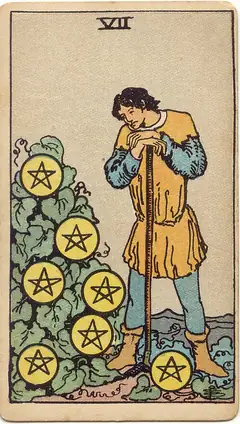
Seven of Pentacles, the card as Pamela Colman Smith drew it for the 1909 Rider-Waite-Smith deck
Seven of Pentacles in the 1909 Rider-Waite-Smith deck, drawn by Pamela Colman Smith. Public domain; scan from Wikimedia Commons.
In short

The Seven of Pentacles is the pause in the middle of the work. The seeds have been planted and tended, the harvest has not come, and the gardener stops to look at what he has grown. It is the tarot’s card of honest assessment: not the effort itself, and not the reward, but the moment of asking whether the effort is on course.

A man leaning on his hoe, looking at the bush

In the Rider-Waite-Smith deck (Pamela Colman Smith, 1909), a young man in a tunic leans on the handle of a hoe, resting after labour. He looks at a thick bush that carries seven pentacles as though they were fruit. The pentacles grow on the plant, which carries the idea that results come from time and tending and not from force.

The hoe tells you he has worked for this, and the way he leans shows that the work is paused and not finished: he is checking. His expression is thoughtful and not especially joyful. That is why the card invites a mixed reaction, with pride in what has grown and a question about whether it is enough, or what might be done differently.

Letting a relationship grow at its own pace

Upright, the Seven in love tends to describe a relationship that is growing slowly and steadily, or a person who is patient about finding the right partner. It suggests that you can invest in a connection without forcing a timetable, and take stock of how it is developing.

Reversed, it can reflect impatience with a relationship that seems stalled, or a feeling that you put in more than you receive. A calm approach is to have an honest conversation about direction instead of simply waiting and worrying. The card cannot say whether a relationship is worth continuing; that is for you to weigh, with a counsellor’s help if you want it.

Feelings and advice from the garden

As feelings, the card suggests quiet satisfaction mixed with uncertainty about whether the wait is worth it, or weariness from long effort. As advice, it says: be patient, keep tending and check your progress honestly. Reversed, the advice is to stop and consider whether a change of method would serve you, and to take a proper rest if you need one.

A question to reflect on: what have you been growing for a long time, and what does it need from you next, whether patience, a change of approach or simply rest? What would count as enough?

Read the full guide5 more sections: the background, the history and where it comes from

Tarot is a tool for reflection and not a proven way to predict events, so the card does not say whether your work will pay off. It asks how you feel about waiting, and whether the work deserves more time or a change of method.

Seven of Pentacles in a table: why Failure is the wrong word

UprightPatience, assessing progress, steady growth that takes time
ReversedImpatience, frustration, effort that feels wasted, time to rethink
ElementEarth
AstrologySaturn in Taurus (the third decan of Taurus, Golden Dawn)
Numerology7: reflection, assessment, pausing, looking within
Yes or noMaybe: yes, but not yet

The Golden Dawn titles this card “Lord of Success Unfulfilled” and assigns Saturn in Taurus; Aleister Crowley’s later Thoth deck renamed it “Failure”. That name sounds harsh, but it refers to a stalling of expected growth and not to disaster. Saturn stands for time and patience, and Taurus is the sign of steady growth, so the pairing describes slow results. Many modern readers prefer the words “delay” or “reappraisal”.

Patience as an active choice

Upright, the Seven describes an investment of effort that has not fully matured. It might be a business, a course of study, a relationship, a health routine or a creative project: something where you can see some growth but are still waiting for the main result. The advice is to be patient and keep tending, while giving yourself a clear-eyed look at progress.

It works as a card of review too. Is the plant healthy? Is the ground right? Should you water, prune or plant something else? Pausing to evaluate is part of good work, and this card gives permission to do it. Seven also sits in the middle of the run from one to ten, and the tradition reads the number as reflection; see life path number 7 for that number elsewhere on the site.

Between guarding and training: the Four and the Eight

The Four of Pentacles showed holding tightly to what is yours, while the Seven shows loosening your grip and letting it grow. The Eight of Pentacles shows the work that follows, with the craftsman bent over his task, so the Seven is the one place in the sequence where the worker looks up.

The Hermit is a Major Arcana card with a similar spirit of pausing and reviewing. The Hermit withdraws to find wisdom; the gardener only stops to take stock, then goes back to the field.

When the waiting turns to frustration

Reversed, the patience is strained. The card can describe frustration at slow returns, feeling that your work has been wasted, rushing things that need time, or a project that was not well thought out at the start. It can also signal a healthy decision to change course because an approach is not working.

There is no doom in it. A reversed Seven is frequently the moment to ask whether more of the same effort is what is needed, or whether a different plan will serve you better. Sometimes the kindest advice is to rest, sometimes to redirect, and only you can tell which, although a trusted friend or mentor may see it more clearly.

Long projects, early businesses and slow savings

Upright, it is a card for long-term projects, careers that build over years, businesses in their early stage and savings habits that compound slowly. It is about perseverance and review. It describes a theme and is not a forecast of results or financial advice.

Reversed, it may show frustration with slow progress, a project that is not delivering, or effort put into the wrong thing. Practical steps include setting clear milestones, checking whether your expectations were realistic, and seeking advice from a qualified professional for financial decisions. Reassessing is a sign of good judgement and not of failure.

Frequently asked questions

↳ What does the Seven of Pentacles mean in a yes or no reading?

It generally means maybe, or yes but later. The card describes growth that is under way and needs more time.

↳ Is the Seven of Pentacles a bad card?

No. Although the Thoth deck title is Failure, in practice it describes waiting, reassessing and patience. Most modern readers treat it as a neutral or encouraging card about slow growth.

↳ What does the Seven of Pentacles mean in love?

Upright, a relationship growing at a steady pace or patience while looking for a partner. Reversed, frustration at a stalled connection or a sense of putting in more than you receive.

↳ What does the Seven of Pentacles reversed mean?

Commonly impatience, frustration or effort that feels wasted. It often prompts a review of your plan rather than a simple decision to quit.

↳ What is the astrology of the Seven of Pentacles?

In the Golden Dawn system it is Saturn in the third decan of Taurus. Saturn stands for time and patience, and Taurus is the sign of steady growth.