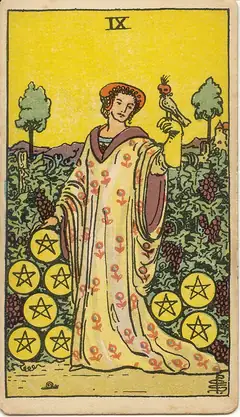
Nine of Pentacles, the card as Pamela Colman Smith drew it for the 1909 Rider-Waite-Smith deck
Nine of Pentacles in the 1909 Rider-Waite-Smith deck, drawn by Pamela Colman Smith. Public domain; scan from Wikimedia Commons.
In short

The Nine of Pentacles shows one woman, alone in a vineyard, at ease in a place she has helped to grow. Of all the Pentacles it is the card most about solitude and self-reliance: comfort that was earned by you and is enjoyed by you, without a crowd to share it. Reversed, it asks whether that comfort is real or only presented well.

Nine of Pentacles in a table: keywords and correspondences

UprightIndependence, self-sufficiency, enjoying your hard-won comfort
ReversedOverwork, insecurity, reliance on appearances or on others
ElementEarth
AstrologyVenus in Virgo (the second decan of Virgo, Golden Dawn)
Numerology9: completion, near the end of a cycle, wisdom
Yes or noYes

The Golden Dawn titles this card “Lord of Material Gain” and assigns it Venus in Virgo; Crowley’s Thoth deck calls it “Gain”. Venus, the planet of pleasure and beauty, sits in the precise, practical sign of Virgo, which fits the idea of refined comfort earned through care.

Self-sufficiency in love

Upright, the Nine in love often suggests being content and whole in yourself, whether single or partnered. A person who draws it may enjoy their own company and be looking for someone to share a good life with, not to fill a gap. Within a relationship it can describe two self-reliant people who respect each other’s independence.

Reversed, it may suggest loneliness behind a polished exterior, difficulty letting anyone near, or a pull towards comfort and security as the main reason for a bond. A kind reading is to ask what you would like to share, and whether your independence has become a wall. The card cannot tell you whether to stay or go; that decision belongs to you, and a counsellor can help if it feels heavy.

Reward, rest and the cost of appearances at work

Upright, the card can reflect rewarding work, practical self-sufficiency and recognising the results of your efforts. It describes a theme and not a guaranteed outcome, and it is not financial advice.

Reversed, it may point to overwork, spending to keep up appearances, or anxiety about security despite apparent comfort. The grounded response is to separate what you need from what you feel you ought to display, to rest properly, and to consult a qualified professional about any real financial decision.

Feelings and advice from the vineyard

As feelings, the card suggests contentment, pride and quiet confidence, or in reverse, restlessness and worry that it could all slip away. As advice, it says: enjoy what you have earned, trust your own judgement and spend time in your garden. Reversed, the advice is to rest, let go of appearances and accept support.

A question to reflect on: what have you built that you rarely stop to appreciate? Is there anything in your life that looks like comfort from the outside but does not feel like it from within?

Read the full guide4 more sections: the background, the history and where it comes from

Tarot is a tool for reflection and not a proven way to predict events, so the card does not promise comfort or wealth. It asks what you have built and whether you let yourself enjoy it.

A woman, a falcon and a snail: what Pamela Colman Smith drew

In the Rider-Waite-Smith deck (Pamela Colman Smith, 1909), a woman in a patterned gown stands among heavy vines, nine pentacles hanging among them like ripe fruit. A hooded falcon perches on her gloved left hand, and her other hand rests near one of the pentacles. A snail creeps along the ground at the lower left, and on the slope behind her stands a large house or estate.

The hooded falcon is a trained bird of prey, a wild and powerful creature that she has learned to handle, and it is usually read as instinct held under discipline. The snail has caused much discussion. Some read it as slowness, meaning that this prosperity came gradually; others as a creature that carries its own home. The artist left no explanation, so both are interpretations. What is not in doubt is her expression: she is alone, but she does not look lonely.

Contentment without an audience

Upright, the Nine of Pentacles points to satisfaction in independence. You may have reached a stage where your own effort has produced stability, and the card encourages you to notice it. Typical themes are managing your own affairs, a home that feels like yours, a good quality of life, and a sense of worth that does not depend on anyone’s approval.

It also carries the idea of refinement: taste, routine and small pleasures that are cultivated and not flashy. The advice is to recognise what you have built, rest in it and avoid the habit of moving the goalposts. The Eight of Pentacles is the labour, and this card is what that labour can feel like once it begins to bear fruit. Where the Eight is absorbed in the work, the Nine has stepped back to look at it.

Where the Nine differs from the Ten

Both cards sit near the end of the suit, but they answer different questions. The Nine is about a single person’s reward and her own judgement; the Ten of Pentacles widens the picture to family, inheritance and several generations. A reader who draws the Nine is often being asked about what is yours, not what is shared. The Empress, the Major Arcana card of abundance, is a useful contrast: she is generous and surrounded, while the woman in the vineyard is self-contained.

In numbering, nine sits near the close of a run from one to ten, and the tradition links it with completion and hard-won wisdom. See life path number 9 for how that number is read elsewhere on the site.

When the vineyard becomes a performance

Reversed, the comfort is unsettled. The card can point to overwork, where you keep striving and cannot rest; to a show of success that hides insecurity; or to reliance on other people’s support. It may also describe the loneliness that independence sometimes brings.

It is gentle in tone. A reversed Nine is a prompt to ask whether you are chasing more than you need, whether appearances are taking too much of your energy, and whether independence has tipped into being cut off. Sometimes the answer is rest, and sometimes it is letting someone in.

Frequently asked questions

↳ What does the Nine of Pentacles mean in a yes or no reading?

It leans clearly towards yes, particularly for questions about comfort, independence and reward for effort. As always, it reflects a tendency and not a guarantee.

↳ What does the falcon mean in the Nine of Pentacles?

A hooded falcon is a trained bird of prey, usually read as instinct brought under discipline. It is an interpretation, since no explanation from the artist survives.

↳ What does the Nine of Pentacles mean in love?

Upright, contentment and independence, whether single or partnered. Reversed, it can suggest loneliness behind a polished surface or difficulty letting anyone close.

↳ What does the Nine of Pentacles reversed mean?

Often overwork, insecurity about what you have, or dependence on others. It suggests reviewing where your energy goes and allowing yourself to rest.

↳ What is the astrology of the Nine of Pentacles?

In the Golden Dawn system it is Venus in the second decan of Virgo, titled Gain in Crowley's Thoth deck. Venus brings pleasure and beauty and Virgo brings care and practicality.