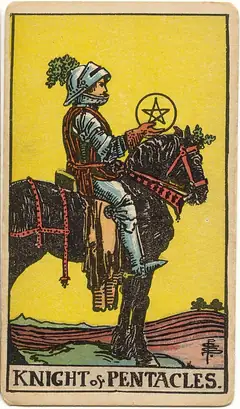
Knight of Pentacles, the card as Pamela Colman Smith drew it for the 1909 Rider-Waite-Smith deck
Knight of Pentacles in the 1909 Rider-Waite-Smith deck, drawn by Pamela Colman Smith. Public domain; scan from Wikimedia Commons.
In short

The Knight of Pentacles is the knight who does not charge. He sits on a horse that stands perfectly still and studies the coin in his hand. Upright he stands for reliability, thoroughness and slow, steady progress; reversed, for stagnation, stubbornness or perfectionism that delays everything.

Knight of Pentacles at a glance

UprightDependability, thoroughness, patience, steady effort
ReversedStagnation, stubbornness, boredom, perfectionism
ElementFire of Earth (Golden Dawn court system)
AstrologyVirgo (Golden Dawn arc: 20 degrees Leo to 20 degrees Virgo)
NumerologyCourt card, sometimes counted as 12 in a full-deck numbering, which reduces to 3
Yes or noYes, but slowly

In the Golden Dawn scheme the Knight is Fire of Earth, described as energy put to steady, practical use, and it rules the arc from 20 degrees Leo to 20 degrees Virgo. Court card attributions vary between authors, and this site follows the Golden Dawn scheme.

Upright: the person who finishes what they begin

Upright, the card points to diligence and dependability. It might describe a task needing care and repetition, a project built gradually, or someone who can be relied on to finish. Words such as methodical, responsible and loyal suit him.

He is practical about time: progress may seem slow but it is real. The advice is to accept a steady pace, break the work into stages and value completion over speed. As a person he is the colleague or partner who is not showy but always delivers.

Reversed: when caution turns into standing still

Reversed, steadiness can become stagnation. The card may describe stubbornness, refusal to change an approach that no longer works, a routine that has become dull, or perfectionism that delays everything. It can also describe working so hard at the detail that the bigger picture is lost.

It may equally describe the reverse: someone or something unreliable, careless or incomplete. A gentle reading asks whether caution has become fear, and whether a small risk or change in routine would help. Patience is a strength only when it is moving in a chosen direction.

Love: affection shown through actions

Upright, the card in love describes a steady, loyal, slow-to-start relationship. A person like this may show affection through actions rather than words: turning up, fixing things, remembering practical details. It can describe a dependable partner, or a bond that develops gradually and solidly.

Reversed, it may indicate a relationship settled into routine, a partner resistant to change or emotionally reserved, or too much focus on practicalities. A kind response is to add something unplanned, such as a change of scene, and to say aloud the warmth that may otherwise only be shown through deeds. The card does not say whether a relationship should continue.

Work and money: long projects and reliable hands

Upright, this is a strong card for careful, long-term work: projects needing consistency, careers that reward reliability and jobs with responsibility. It describes a theme and does not forecast results, and it is not financial advice.

Reversed, it may suggest work that feels stuck, resistance to new methods, perfectionism or overwork. Practical steps include setting a deadline that lets good work be called finished, and asking a colleague for a fresh view. For real financial choices a qualified professional is the right source of advice.

Feelings and advice: keep going, check the routine

As a feeling, the card describes steadiness, a sense of duty and a cautious approach, or in reverse, frustration at being stuck.

As advice it says: keep a steady pace, do the work properly and be someone others can rely on. Reversed, check whether your routine still serves you, and change one small thing.

Steady effort and the habits you keep

Where in your life would steady, unglamorous effort do more than speed? Which habit or method are you holding on to simply because it is familiar?

Read the full guide3 more sections: the background, the history and where it comes from

Tarot is a tool for reflection and not a proven way to predict events, so use the Knight as a question about pace. He may describe a person you know, a quality you could use, or a way of approaching a task: carefully and without shortcuts.

A motionless horse in a ploughed field

In the Rider-Waite-Smith deck (Pamela Colman Smith, 1909), a knight in dark armour sits on a heavy black horse in a ploughed field. The horse stands still. The knight holds a single pentacle out in front of him and studies it. His helmet and the horse’s bridle carry leaves that are usually read as oak, a tree associated with strength and endurance. The field is neatly furrowed and the sky pale.

Stillness is the unusual detail. The Knights of Wands and Swords are shown in motion, but this knight is stationary. The suggestion is that patience is a form of movement, and that the ground to be covered is the field itself, row by row. The dark, sturdy horse looks like a working animal and not a racer. He is ready to go forward, but only once he is sure of the next step.

Where the Knight sits between the Page and the Queen

The Page of Pentacles is the student gazing at a coin; the Knight is the student who has turned study into routine and now carries a job through. The Queen of Pentacles comes next in the court, bringing warmth and household care to the same practical skill.

Compared with the Seven of Pentacles, which also deals with patience, the Knight is less about waiting for growth and more about doing the repeated work that produces it.

The Chariot as the opposite kind of drive

Readers sometimes pair the Knight with The Chariot, a Major Arcana card of forward drive and willpower. The two show contrasting ideas of progress: the Chariot advances by force of will, the Knight by patience and care. Seeing them together can prompt the question of which approach the situation actually needs.

Frequently asked questions

↳ What does the Knight of Pentacles mean in a yes or no reading?

It leans towards yes, with the caveat that the pace will be slow and methodical. It suggests that patience and thoroughness will be needed.

↳ Why is the horse standing still on the Knight of Pentacles?

It is usually read as a sign that patience and steady work are valued in this suit. The Knights of Wands and Swords are shown in motion, so the stillness is a deliberate contrast, although the artist left no written explanation.

↳ What does the Knight of Pentacles mean in love?

A loyal, steady and practical partner, or a relationship that grows slowly. Reversed, it can suggest routine, reserve or resistance to change.

↳ What does the Knight of Pentacles reversed mean?

Often stagnation, stubbornness, boredom or perfectionism. It invites you to check whether caution has become avoidance.

↳ What is the astrology of the Knight of Pentacles?

Virgo. The Golden Dawn arc runs from 20 degrees Leo to 20 degrees Virgo, and this site follows that scheme.

See Virgo for the sign linked to this card, and life path number 3 for the number a court card counted as 12 reduces to.