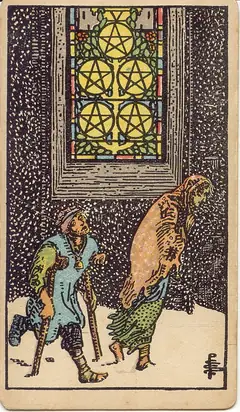
Five of Pentacles, the card as Pamela Colman Smith drew it for the 1909 Rider-Waite-Smith deck
Five of Pentacles in the 1909 Rider-Waite-Smith deck, drawn by Pamela Colman Smith. Public domain; scan from Wikimedia Commons.
In short

The Five of Pentacles shows hardship, but it is a card about help that goes unseen as much as about need. Upright it describes worry, feeling shut out or struggling alone while support stands close by. Reversed it often describes recovery, or a stubborn isolation in which help is available but not used.

Five of Pentacles at a glance

UprightHardship, worry, feeling excluded, help close at hand
ReversedRecovery, accepting help, or being stuck in isolation
ElementEarth
AstrologyMercury in Taurus (the first decan of Taurus, Golden Dawn)
Numerology5: change, instability, challenge, movement
Yes or noUsually no, or not yet

The Golden Dawn titles this card “Lord of Material Trouble” and assigns Mercury in Taurus, the thinking planet in the sign of material security, which describes anxious thought about resources well. Crowley’s Thoth deck calls the card “Worry”.

Upright: money worries, health worries, the outside looking in

Upright, the card describes a hard stretch: financial worry, health worry, feeling out in the cold at work or in a group. It is frequently drawn by people whose finances are perfectly sound but who feel insecure, so it does not say that loss is coming.

The constructive reading is to look for the lit window: a friend, a service, an adviser, a community or a doctor who could make the load lighter. Pride and exhaustion can make us walk past the open door.

Reversed: the snow begins to melt, or the door stays unopened

Reversed, the card can signal recovery, a willingness to accept help, a change in circumstances or release from a long period of worry. It is often a relief to draw.

It can also describe the opposite: staying isolated, believing you do not deserve support, or struggling alone when that is no longer necessary. Then the card is a gentle prompt to reach out. If the struggle includes health or mental wellbeing, speaking to a doctor or other qualified professional is the sensible step, and a card is no substitute.

Love: lonely, unseen or strained by practical worries

Upright, the card in love can suggest loneliness, feeling unseen or outside a circle, or a relationship under strain from practical worries. It may also describe the weeks after a breakup when you feel cut off. It does not say a relationship will fail.

Reversed, it can suggest the chill is lifting through a reconnection, an honest conversation or letting someone in. The kind reading is to tell a trusted person how you really feel. Shared hardship can sometimes deepen a bond, and the two figures walking side by side hint at that.

Work and money: have you told the right people?

Upright, the card commonly arises around financial stress, job insecurity, a lean stretch or feeling excluded at work. It does not predict loss and is not financial advice. Its practical question is whether you have told the right people and used the help available, such as a financial adviser, a debt charity, a union or a trusted colleague.

Reversed, it often suggests recovery or readiness to ask for support, but it can also flag the habit of hiding difficulties out of embarrassment. Real money problems deserve real advice from qualified people. A card can only help you notice how you feel about them.

Feelings and advice: look up

As a feeling, the card describes worry, fatigue, shame about needing help, or a sense of being on the outside. It can also be how someone else feels whom you have not noticed.

As advice it says: look up, ask for help and accept it when it is offered. Reversed, the advice is to let the improvement register and keep reaching out, rather than waiting until you feel you have earned support.

Read the full guide4 more sections: the background, the history and where it comes from

It worries many people, yet tarot is a tool for reflection and not a proven way to predict events. Read it as a picture of a feeling, not a forecast of poverty or loss.

Two figures in the snow and a window they do not look at

In the Rider-Waite-Smith deck (Pamela Colman Smith, 1909), two people trudge through falling snow at night. One is a barefoot woman wrapped in a shawl, head bowed. The other is a man with bandaged or injured legs who moves on crutches and wears a bell, a detail some readers connect with the warning bells once carried by people with contagious illness. Behind them a large stained-glass window glows, showing five pentacles arranged in a pattern many readers link to the Tree of Life.

The window belongs to a church or shelter, a place of warmth and community, and the pair pass it without looking up. That is the heart of the card. Nobody has refused them; they simply have not turned their heads. They are also walking together, a quiet sign that neither is entirely alone.

Why this is the card of feeling left out rather than running out

Among the pentacles, the Five is the one most about belonging. The Four of Pentacles shows scarcity hardening into a tight grip on what you have, while the Five shows the opposite posture: nothing held, and no one asked. Its sequel, the Six of Pentacles, shows help finally being given and received.

Another feared card that is not literal

Readers often compare this card with The Tower, which also looks alarming but is usually read as a sudden clearing away of something unstable rather than as disaster. The Five of Cups shows a related theme of loss in the emotional suit: there the figure fixates on spilled cups, here the figures overlook a shelter.

The lit window, near you

If a lit window were near you right now, what might it be, and what has kept you from knocking? Who in your life would want to know how hard this has been?

Frequently asked questions

↳ Is the Five of Pentacles a bad card?

It shows a difficult feeling but not a fixed fate. It is often read as a prompt to seek help, and it includes a visible source of shelter in the image. It describes how a situation may feel and does not predict loss.

↳ Does the Five of Pentacles mean I will lose money?

No. Tarot cannot predict your finances, and this card is frequently drawn by people who simply feel insecure. It is better read as a nudge to check in on your worries and to use the support that exists.

↳ What does the Five of Pentacles mean in a yes or no reading?

It generally leans towards no or not yet, because it describes difficulty and a lack of support at the time of asking. Many readers add that the answer can change if help is sought.

↳ What does the Five of Pentacles reversed mean?

Often recovery and acceptance of help. It can also suggest lingering isolation, where the support is there but you are not using it.

↳ What is the stained-glass window in the Five of Pentacles?

It shows five pentacles in a pattern many readers link to the Tree of Life, and it marks a place of warmth and community. Its meaning is interpretive, but most readers see it as help that is present but unnoticed.

See Taurus for the sign of this card’s decan, and life path number 5 for the number of change.