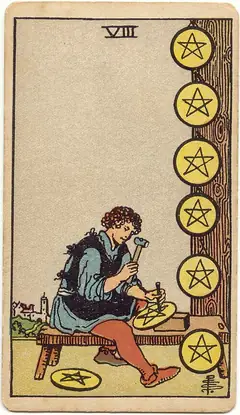
Eight of Pentacles, the card as Pamela Colman Smith drew it for the 1909 Rider-Waite-Smith deck
Eight of Pentacles in the 1909 Rider-Waite-Smith deck, drawn by Pamela Colman Smith. Public domain; scan from Wikimedia Commons.
In short

The Eight of Pentacles is the card of practice: one person, one bench and the same task repeated until it is done well. Upright it stands for apprenticeship, diligence and the quiet satisfaction of improving by doing. Reversed it points to perfectionism, boredom, careless work or burnout.

Eight of Pentacles at a glance

UprightFocused effort, developing skill, dedication to a craft
ReversedPerfectionism, tedium, rushed or careless work, lost direction
ElementEarth
AstrologySun in Virgo (the first decan of Virgo, Golden Dawn)
Numerology8: effort, power, mastery, cause and effect
Yes or noYes, with hard work

The Golden Dawn titles this card “Prudence” and pairs it with the Sun in Virgo. Virgo is the sign of skill, attention to detail and service, which suits a craftsman perfecting his work.

Upright: getting better at something by doing it

Upright, you may be learning a craft, training for a profession, practising an instrument, revising for exams, or simply getting the small details of a task right. The card values repetition and patience and treats mastery as something that accumulates piece by piece.

The advice is to choose what deserves your effort, give it full attention and let progress be gradual. Satisfaction in honest labour is the theme, not applause.

Reversed: when repetition stops meaning anything

Reversed, the quality of attention is blocked. Readers commonly link it to perfectionism that never lets work be finished, repetition without purpose, work done carelessly to get it over with, or a job that has lost its meaning. It can also indicate burnout from pouring everything into one task.

It is not a judgement of your character. A reversed Eight often prompts the question of whether you still want what you are working towards, or whether the method needs to change. Sometimes good enough really is enough, and sometimes a change of direction is wiser than more effort.

Love: patience as a daily practice

Upright, the card in love speaks of real work put into a relationship: learning each other’s needs, practising patience and communication, and building something through small consistent acts. For someone single, it can suggest a period of self-development, though the town in the picture is a reminder not to lose touch with other people.

Reversed, it may show a relationship starved of energy because work or another absorbing task takes everything, or a sense of being stuck in routine. A gentle reading is to make time deliberately for connection and bring some freshness to the everyday. It says nothing about whether any relationship should continue.

Work and money: training, standards and knowing when to stop

This is among the most work-focused cards in the deck. Upright it points to training, apprenticeship and careful, high-quality work, and suggests steady effort tends to improve your position over time. That is a theme, not a promise of promotion or pay, and not financial advice.

Reversed, it can refer to a dull job, burnout, cutting corners or unclear direction. Practical steps include setting a realistic standard for completion, taking genuine breaks and asking whether your effort is pointed at what you care about. For concrete decisions about money or a career change, a qualified adviser can offer what a card cannot.

Feelings and advice: finish the next piece

As a feeling, the card describes absorption, pride in doing something properly, or weariness from repetition. Reversed, it could mean restlessness or the sense that effort is going unrewarded.

As advice it says: keep practising, attend to the detail, and focus on the next piece rather than the whole. Reversed, the advice is to put the tools down for a moment and ask whether you are working for the right reasons.

Read the full guide4 more sections: the background, the history and where it comes from

Tarot is a tool for reflection and not a proven way to predict events, so the card does not guarantee success. It asks what you are giving steady attention to, and whether you still care about it.

A craftsman with his back to the town

In the Rider-Waite-Smith deck (Pamela Colman Smith, 1909), a young craftsman in an apron sits at a wooden bench, hammer and chisel in hand, carving a pentacle into a coin. Finished coins are displayed beside him and at his feet, and the one under his hands is still unfinished. Far off, small and pale, a town sits on a hill.

The town is the detail that sets this card apart from its neighbours. He has turned away from it, which can be read as chosen focus, or as a mild warning about isolation. There is no audience and no customer in the picture. The reward on offer is the quality of the work itself.

Late in the suit: after the hoard, before the harvest

Numbered eight, the card sits late in the pentacles sequence, after the shared building of the Three of Pentacles and the guarded hoard of the Four of Pentacles. Where the Three puts a skill to work among other people, the Eight shows the private practice that makes the skill possible. The Nine of Pentacles shows a later stage, where years of effort have produced something to enjoy.

That placement explains the card’s tone. Nothing here is a beginning and nothing is a conclusion. It is the long, unglamorous stretch, which is why the same image can feel like contentment on one day and tedium the next.

Two Major Arcana cards of quiet discipline

Readers often set this card beside The Hermit, where solitude serves a search for understanding, and Strength, where patience and steadiness do the work. With the Hermit the theme is withdrawal for a purpose, which echoes the craftsman’s turned back. With Strength it is gentle persistence over force.

Questions about your own practice

What skill or task would you like to be better at in a year, and what small piece of practice could you do this week? Where are you working hard, and is it still for something you want?

Frequently asked questions

↳ What does the Eight of Pentacles mean in a yes or no reading?

It leans towards yes, provided you are willing to put in steady effort. The card rewards diligence and does not promise quick results.

↳ What does the Eight of Pentacles mean for career?

It is usually read as a card of learning, training and dedicated work. It suggests that focused practice builds skill over time. It is not a guarantee of any particular outcome.

↳ What does the Eight of Pentacles reversed mean?

Often perfectionism, boredom, rushed work or burnout. It invites you to review your direction and pace rather than simply work harder.

↳ What does the Eight of Pentacles mean in love?

Upright, effort and patience put into a relationship, or self-development while single. Reversed, a relationship neglected because work takes over, or stuck in routine.

↳ What is the astrology of the Eight of Pentacles?

In the Golden Dawn system it is the Sun in the first decan of Virgo, called Prudence. Virgo is associated with skill, detail and practical service.

See Virgo for the sign of this card’s decan, and life path number 8 for the number of effort and mastery.