
Card 10: the Major Arcana turns a corner
| Upright | Cycles, change, turning point, fortune |
| Reversed | Resistance to change, setbacks, loss of control |
| Element | Fire |
| Astrology | Jupiter |
| Numerology | 10, which reduces to 1 (1 + 0): the end of one cycle and the start of the next |
| Yes or no | Leans yes, as things are moving |
A wheel of letters and symbols in the clouds
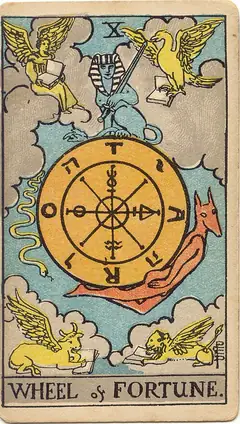
In the Rider-Waite-Smith deck (Pamela Colman Smith, 1909), a large wheel hangs in a blue sky among clouds. Around its rim are the letters T, A, R, O, which can be rearranged as ROTA (Latin for wheel) and TARO, together with Hebrew letters usually linked to the four-letter name of God. Inside the wheel are alchemical symbols, commonly identified as mercury, sulphur, water and salt.
Three figures ride the wheel. A serpent, often identified with the Egyptian god Typhon, descends on one side, while a jackal-headed figure like Anubis rises on the other. At the top sits a sphinx holding a sword, a still point above the motion. In the four corners are winged figures, a man, an eagle, a lion and a bull, each holding a book. They are read as the four evangelists in Christian tradition and as the four fixed signs, Aquarius, Scorpio, Leo and Taurus, in astrology. The mix of Egyptian, alchemical, Hebrew and Christian symbols means several readings are valid.
Upright: something is turning
Upright, the Wheel signals movement. Something in your circumstances is changing, often beyond your control, and the change may be welcome or challenging. It can appear at a turning point such as a new job, a move or a sudden opportunity, or when a long pattern finally shifts.
Jupiter, the planet linked with the card, is associated with growth and good fortune, so many readers see the upright Wheel as favourable. Its deeper lesson is that no state lasts forever, good or bad.
Reversed: holding on while the wheel turns
Reversed, the Wheel often suggests resistance: holding on to something that is ending, or feeling that events are working against you. It can describe a frustrating period where nothing seems to move, or a sense of repeating old patterns.
A gentle reading treats the reversal as a prompt to look at what you can influence. You cannot turn the wheel, but you can decide how to meet it. Some readers also take it as a sign that timing is not yet right, rather than that anything has gone wrong.
In love: a new stage, or a pattern you keep repeating
Upright, the Wheel in love can suggest a new stage: a meeting that feels well timed, a relationship deepening, or a shift that opens new options. It is also a reminder that relationships change over time and that flexibility keeps them healthy.
Reversed, it may indicate repeating patterns, bad timing or difficulty accepting change in a partner or in yourself. It can ask what you keep repeating. It does not predict the end of a relationship, and it does not tell you to stay or leave.
In work and money: using the turn well
Upright, it often points to a turning point at work, for example a change of role, an opportunity that appears or a shift in your industry. It favours adaptability. Luck plays a part, but preparation helps you use it.
Reversed, it may suggest a delay, an unexpected setback or a period where results do not match effort. This is reflection and not financial advice, so for money decisions speak with a qualified professional.
Feelings and advice when the ground shifts
As feelings, the Wheel describes a sense of change in the air, sometimes excitement, sometimes uncertainty; reversed, it can describe feeling stuck or at the mercy of events. As advice, it says to stay flexible, use the turning while it is on your side and stay steady when it is not.