
The Hanged Man in brief: keywords, Water and the number 12
| Upright | Pause, surrender, new perspective, letting go |
| Reversed | Stalling, resistance, needless sacrifice |
| Element | Water |
| Astrology | Neptune in modern decks; the Golden Dawn assigned the element Water |
| Numerology | 12, which reduces to 3 (1 + 2) |
| Yes or no | Uncertain: wait |
A calm face, a living tree and a halo
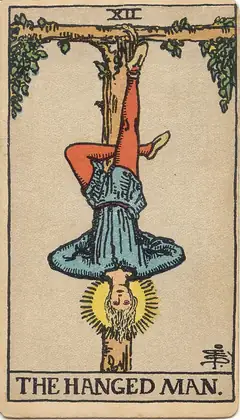
In the Rider-Waite-Smith deck (Pamela Colman Smith, 1909), a young man hangs upside down from a T-shaped wooden frame, suspended by one ankle. The frame is a living tree, with green leaves, not a gallows. His other leg is bent behind the straight one, forming a shape like the number 4, and his hands are folded behind his back, forming a triangle with his head.
What stands out is his expression: his face is calm, even serene, and a halo of golden light surrounds his head. He wears a blue tunic and red trousers, with yellow shoes, and the background is plain pale blue. He is not struggling. He has chosen, or accepted, his position. The upside-down view suggests that the world looks different from here, and that what seemed clear may need turning over.
Upright: waiting with a purpose
Upright, The Hanged Man stands for a pause with a purpose. You may be waiting for a decision, or choosing not to act until you understand more. It can also mean willingly giving something up, such as a habit, a position or an old way of seeing, in order to gain something more valuable.
The card is about perspective. By looking at a problem from the opposite angle, you may notice options that were hidden. It encourages patience, and a release of the urge to force a result. The halo suggests that the pause itself can bring insight, and many readers connect it with surrender in a spiritual sense, meaning trust and not defeat.
Reversed: a pause that has gone on too long
Reversed, The Hanged Man can describe a pause that has dragged on, or resistance to a change that needs to happen. You might be stalling, postponing a decision or making sacrifices that no one has asked for and that do not help. It can also suggest feeling stuck and unable to see another angle.
Read gently, the reversal is a prompt to ask whether the waiting is still useful. Sometimes the answer is to act. Sometimes it is to stop sacrificing for a person or cause that does not value it. There is no harm in this card, reversed or not.
A relationship on hold
Upright in love, it suggests taking time before a decision, looking at a relationship from your partner’s point of view, or letting go of a need to control how things unfold. It can also describe a relationship on hold, which may be a useful pause.
Reversed, it may suggest being stuck in a situation that is not moving, or giving more than you receive. It invites you to ask whether you are waiting for something that will not come, and to decide what you need.
Delay, review and a fresh approach at work
Upright, it can point to a period of delay or review, where progress seems slow but reflection is worthwhile. It favours a fresh approach over more effort in the same direction, and may describe a voluntary change of course.
Reversed, it may indicate procrastination, fear of a decision or working hard without reward. This is reflection and not financial advice. For money decisions, consult a qualified professional.