
A driver with no reins
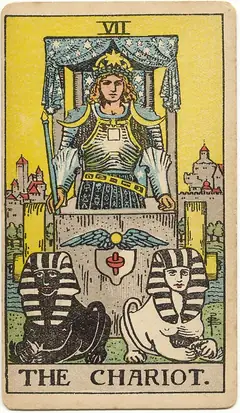
In the Rider-Waite-Smith deck (Pamela Colman Smith, 1909), a young figure in armour stands upright in a chariot under a canopy of stars. He wears a laurel wreath with a star on it, and there are crescent moons on his shoulders. In one hand he holds a short wand. Notably, he holds no reins.
The chariot is drawn by two sphinxes, one black and one white, resting in front of him. They are often read as opposing forces, such as light and dark, or impulse and restraint, which he steers by will alone. On the front of the chariot is a winged emblem, and the body of the chariot carries symbols that many link with the union of opposites. Behind him are a walled city and a river, which can be read as the life he has left or the goal ahead.
How The Chariot differs from Strength
The Chariot comes after The Lovers, where a choice was made, and before Strength. The pairing is instructive. The Chariot masters through direction and will, with the driver upright, armoured and moving. Strength, the next card, shows a gentler mastery in which a woman calms a lion without a struggle. Read as a sequence, they suggest that drive comes first and tenderness refines it.
The Chariot in brief: keywords, element and number
| Upright | Determination, direction, willpower, victory through focus |
| Reversed | Lost direction, aggression, scattered drive |
| Element | Water |
| Astrology | Cancer |
| Numerology | 7, the number of inner work, study and purpose |
| Yes or no | Leans yes, with effort |
The Cancer link is one traditional assignment, and some readers connect the moons on his shoulders with the Moon, which rules Cancer. You can read more about Cancer, and the number 7 is covered in the life path number 7 guide.
Upright: a goal, a direction and the focus to reach it
Upright, The Chariot stands for willpower and momentum. It can appear when you are starting a demanding project, travelling, or deciding to stop drifting and choose a path. Victory, in the card’s language, is something built through preparation rather than luck.
Reversed: when the reins have slipped
Reversed, The Chariot can indicate energy that is blocked, scattered or used too forcefully. You may feel unable to choose a direction, pulled two ways, or pushing so hard that you risk burning out. It can also suggest aggression, where the wish to win overrides judgement.
A gentle reading is that it is time to slow down. Identify the two forces pulling against each other, such as duty and desire, and look for what they have in common. It is not a forecast of failure.
The Chariot in love: shared direction
Upright, The Chariot suggests taking initiative in love: pursuing something with confidence, moving a relationship forward, or building a partnership with shared goals. It can also describe two people who are working in the same direction.
Reversed, it may suggest a struggle for control, conflicting agendas or rushing ahead without listening. It can also point to confusion about where a relationship is going. A calm conversation about direction often helps more than pressing harder. The card cannot tell you whether to stay or leave.
The Chariot at work: exams, launches and stamina
Upright, it is a strong card for ambition: promotions, exams, launches and any project that needs stamina. It favours focus over spreading effort across many things, and it can refer to travel for work in a practical sense.
Reversed, it may point to overreach, lack of a clear plan or burnout. This is reflection, not financial advice. For decisions involving money, consult a qualified professional.
The Chariot as feelings, and as advice
As feelings, The Chariot describes determination and confidence, sometimes mixed with tension. Reversed, it describes feeling stuck, frustrated or out of control.
As advice, it says to pick a direction and commit, to align your competing impulses and to rely on discipline rather than force. If you are already tired, consider whether rest is part of the plan.