
Water that never spills
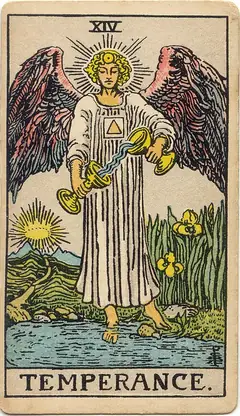
In the Rider-Waite-Smith deck (Pamela Colman Smith, 1909), a winged figure in a white robe stands with one foot on dry land and the other in a pool of water. The figure is often called an angel. On the forehead is a golden circle with a dot in the centre, a symbol also used for the sun, and on the chest of the robe is a square containing a triangle.
In each hand the figure holds a cup, and water flows in an arc between them without a drop spilling. Irises grow by the water’s edge. A path leads from the pool towards distant mountains, and above the peaks a glowing crown of light shines. Standing on both land and water is usually read as moving between the physical world and the emotional or spiritual one, and the flowing water is the image of continuous, careful mixing.
Temperance in brief: keywords, element and number
| Upright | Balance, moderation, patience, harmony |
| Reversed | Excess, imbalance, impatience, discord |
| Element | Fire |
| Astrology | Sagittarius |
| Numerology | 14, which reduces to 5 (1 + 4): change guided by judgement |
| Yes or no | Leans yes, slowly |
This page follows the Golden Dawn assignment, Sagittarius, which is the one used with the Rider-Waite-Smith deck, and other systems vary. Sagittarius is ruled by Jupiter in traditional astrology. For related reading see Sagittarius and life path number 5.
Upright: the careful recipe
Upright, Temperance stands for moderation, balance and patience. It may suggest finding a middle course between extremes, or blending two parts of your life that have felt opposed. It is the card of the careful recipe: the right amount of each ingredient, added at the right time.
It also carries a sense of healing and calm. After a hard stretch, it suggests that recovery comes through small, consistent steps and through looking after all parts of yourself. The path towards the mountains adds a hint of long-term purpose: the journey is gradual, but it leads somewhere. The Sagittarius link adds a wide, searching outlook, using experience to find meaning.
Reversed: too much of one thing
Reversed, Temperance can point to imbalance: too much of one thing, such as work, worry or indulgence, and too little of another. It may also suggest impatience, a wish to rush a process that needs time, or friction between two things that have not yet found a way to work together.
Gently read, it is a prompt to adjust proportions. You might ask what you have been overdoing and what you have been neglecting. Small changes such as regular sleep, a walk or a slower pace often do more than dramatic ones. If stress or habits are affecting your health, a doctor can help.
Temperance in love: give and take
Upright, it suggests a relationship with good balance: give and take, patience with each other’s differences and a sense of harmony. It can mean two people are learning to blend their lives, or that a period of healing is under way after difficulty.
Reversed, it may indicate imbalance, such as one person doing more, differing paces or unresolved tension. It can also suggest rushing into something before you have had time to see how you fit. An honest discussion about needs and timing can help. The card cannot tell you whether to stay in or leave a relationship.
Temperance at work: steady effort over bursts
Upright, it favours steady progress, collaboration, moderation and careful planning. It suits roles that involve mediation, healing, teaching or blending ideas. Sustainable effort is its theme, not bursts of overwork.
Reversed, it may suggest overcommitment, an uneven workload or impatience with results. This is reflection, not financial advice. For decisions about money, consult a qualified professional.
Temperance as feelings, and as advice
As feelings, Temperance describes calm, patience and a sense of inner balance. Reversed, it describes restlessness or being pulled in different directions.
As advice, it says to go gently, find the middle way and let things blend over time. It can also be a nudge towards healthy routines.