
A judge who looks straight at you
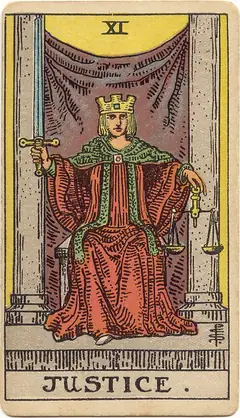
In the Rider-Waite-Smith deck (Pamela Colman Smith, 1909), a figure in a red robe with a green cloak sits on a throne in front of a purple curtain hung between two grey pillars. The head wears a crown topped with a small square ornament. In the right hand is a double-edged sword pointing upwards, and in the left a pair of scales. A small slipper peeks from beneath the robe.
The upright sword is often read as clear thought and the power to decide, and its two edges as a reminder that truth cuts both ways. The scales stand for weighing evidence. The pillars and curtain frame the figure as a judge in court. The gaze is direct and level, as though asking you to look at your own situation with the same honesty.
Justice in brief: keywords, element and number
| Upright | Fairness, truth, accountability, cause and effect |
| Reversed | Unfairness, dishonesty, avoiding accountability |
| Element | Air |
| Astrology | Libra |
| Numerology | 11, a master number in numerology, which reduces to 2 (1 + 1) |
| Yes or no | Leans yes if the facts support it |
The Libra link is natural for a card holding scales. Its master number 11 has its own guide at life path number 11, with the reduced 2 covered in life path number 2. You can also read about Libra.
Upright Justice: facts, promises and consequences
Upright, Justice stands for fairness and truth. It often appears when a decision needs to rest on evidence, when rules, contracts or agreements are involved, or when you are asked to take responsibility for past choices. It can also suggest that you will be treated fairly.
It is about cause and effect, sometimes compared with the idea of karma, though the card does not require any belief about that. In practice it asks you to tell the truth, keep promises and accept where your choices have led. There is relief in this: once the facts are honestly faced, you can move on.
Reversed Justice: when the scales tip
Reversed, Justice can suggest that fairness is blocked or that honesty is missing, either in a situation or in your own thinking. You might feel you are being treated unfairly, or you might be avoiding responsibility for something you did. It may also describe biased judgement, including being too harsh on yourself.
Read gently, it is a prompt to check the facts and look at your own part. If you are facing a legal matter, this card cannot advise you, and you should speak to a qualified solicitor. It is not a sign that a bad outcome is certain.
Justice in love: equal effort and clear agreements
Upright, Justice suggests a relationship based on honesty, equality and clear agreements. It can mean things are balanced, or that an honest conversation will clear the air. It may also point to a commitment made with a clear head.
Reversed, it may indicate imbalance, such as one person doing more, dishonesty or unresolved resentment. It invites a fair and open conversation about what each of you contributes and expects. It does not predict a separation and cannot tell you whether to stay or go.
Justice at work: contracts, records and fair process
Upright, Justice favours contracts, negotiations, regulation, legal or ethical work and getting what you have earned. It supports decisions made on facts and with a fair process, and it can be a reminder to keep accurate records.
Reversed, it may suggest unfair treatment, unclear terms or avoiding a difficult but necessary decision. This is reflection, not legal or financial advice. For contracts, disputes or money decisions, consult a qualified professional.
Justice as feelings, and as advice
As feelings, Justice describes a wish for fairness and clarity, and sometimes a sense of being judged. Reversed, it describes resentment or guilt.
As advice, it says to be honest, weigh the evidence and take responsibility without self-punishment.
A fair outcome, and the fact you may be avoiding
What would a fair outcome look like for everyone involved, including you? Is there a fact you have been avoiding that would make the picture clearer?