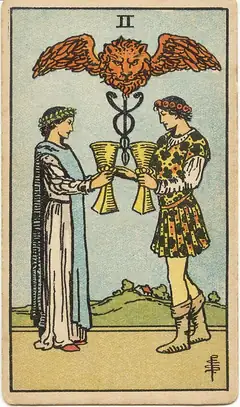

Two of Cups at a glance
| Upright | Mutual attraction, partnership, honest exchange, harmony, a meeting of equals |
| Reversed | Imbalance, poor communication, one-sided effort, a bond that has cooled or stalled |
| Element | Water |
| Astrology | Venus in Cancer (the first decan of Cancer, Golden Dawn attribution) |
| Numerology | 2: duality, cooperation and relationship (see life path 2) |
| Yes or no | Yes, especially where the question is about agreement or partnership |
Upright: something given, something returned
Upright, the card describes reciprocity. Something is offered and something is returned, and both sides can feel it. It is talking to someone who actually listens, or realising that a person has shown up for you as you have for them.
It carries a quiet demand for equality. The couple are matched, so the card asks whether you treat the other person, and yourself, as equals. It can also signal a reconciliation after a quarrel, a clear agreement after long negotiation, or the point at which two people decide to name what they feel.
Reversed: the balance slips
Reversed, one person may be offering more than the other, or conversation has turned into assumptions in place of exchange. The card can describe attraction fading into habit, a partnership with unspoken resentment, or a friendship that has drifted because neither side made the first move.
It need not mean an ending. Often it simply asks for a direct conversation, a clearer boundary or a more honest account of what you need. It can also point inward, to a struggle to balance two parts of yourself, such as head and heart.
In love: easy conversation and early dating
Upright, this is among the warmest love cards. For singles it may describe meeting someone with whom conversation feels easy, or being ready to be met as an equal. In a relationship it celebrates mutual respect, affection and commitment, and it is often read as a good sign in early dating because both people lean in. Readers sometimes compare it with The Lovers, which deals with choice and values, while the Two of Cups is about the warmth of the meeting itself.
Reversed, it often means mismatch: different speeds, different expectations or mixed messages. It invites a check on whether effort is shared. If a relationship feels unsafe or controlling, that is a matter for real support, not for a card.
Work and money: partnerships that feel fair
At work the card suggests productive partnership: a co-founder, a mentor who respects you, a negotiation that leaves both sides satisfied. It favours collaboration over competition. Reversed, it may show a stalled deal, unequal workloads or unclear expectations between colleagues. On money, take it as a reminder to make joint arrangements explicit and fair. This is reflection, not financial advice.
As feelings, and as advice: reach out, and say it kindly
As feelings, the card stands for affection, trust and readiness for closeness, from you or the person you are asking about. As advice, it says to reach out, say the honest thing kindly and look for exchange that nourishes both people.
It follows naturally from the Ace of Cups: once the heart has opened, the two shows what sharing that openness looks like.