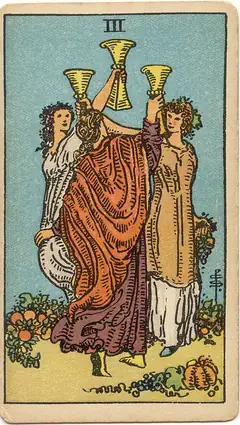

Three of Cups at a glance
| Upright | Friendship, celebration, community, collaboration, shared happiness |
| Reversed | Overindulgence, gossip, exclusion, social exhaustion, a celebration that feels hollow |
| Element | Water |
| Astrology | Mercury in Cancer (second decan of Cancer, Golden Dawn attribution) |
| Numerology | 3: expression, creativity and sociability (see life path 3) |
| Yes or no | Yes, especially for social plans, collaboration and good news |
Upright: joy found in company
Upright, the card is about gladness in company: a gathering, a milestone shared with others, a friendship that has deepened, or a group that works well together. Each dancer holds her own cup, but the gesture only works because all three lift together.
There is also gratitude in it. A harvest follows effort, and the card often appears when something has gone well and it is time to thank the people who helped. During a stretch of hard work, it may be a nudge to book the celebration instead of waiting until everything is perfect.
Reversed: when the circle loosens
Reversed, the circle comes apart in one of two ways. Celebration can go too far, with socialising used as an escape, or friendship groups turning to gossip at someone’s expense. Or you may be the one left out, watching others enjoy themselves and wondering where you fit.
It is a signal, not a verdict, and sometimes it only means social fatigue and a need for quiet. If you notice you rely on drinking or constant company to manage your mood, talk to a doctor or counsellor, as a card cannot substitute. A useful question is whether your connections feel nourishing or merely busy.
Love: couples who are seen, and friendship as love
Upright, the card often describes a relationship supported by friends and community: couples glad to be seen together, introductions to family, engagement or wedding celebrations. For singles it can suggest meeting someone through social circles, or that friendship is currently the emotional warmth you need. Platonic love counts here as much as romantic love.
Reversed, it can point to friends who interfere in a relationship, jealousy within a group, or a partnership that has lost its private warmth because others are always around. Some readers see a third party in a love triangle, though that is one reading among many and depends on your question. Set it against the focused intimacy of the Two of Cups.
Work and money: teamwork and shared credit
At work the Three of Cups favours teamwork: brainstorms, shared credit, a party after a launch, a network that helps you get noticed. It suits creative and service fields where relationships drive the work. Reversed, it may suggest office gossip, cliques, or a team that socialises more than it delivers. On money, it is a mild prompt about shared costs and celebrations: enjoy yourselves within reason. This is reflection, not financial advice.
As feelings, and as advice: say yes, and include someone
As feelings, the card describes warmth, playfulness and belonging. As advice, it suggests accepting the invitation, organising the get-together you keep postponing and thanking those who helped you. It also asks you to include someone who may be on the edge of the group.
For the next step in the suit, see the quieter turn inwards of the Four of Cups.