By Niket JainPublished Updated Drafted with AI tools under Niket Jain's direction, checked before publishing. How we write
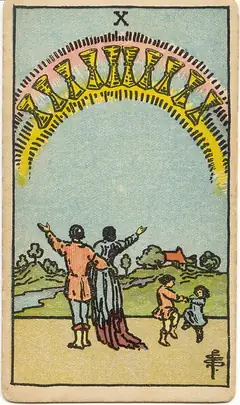
Ten of Cups in the 1909 Rider-Waite-Smith deck, drawn by Pamela Colman Smith. Public domain; scan from Wikimedia Commons.
In short
The Ten of Cups closes the suit with a picture of emotional life going well: a couple, two children, a cottage, and ten cups arched across the sky. Its core idea is fulfilment that is shared, where happiness fills a household rather than belonging to one person.
Family harmony, belonging, emotional fulfilment, lasting happiness, shared joy
Reversed
Family strain, disconnection, an ideal that does not match reality, broken harmony
Element
Water
Astrology
Mars in Pisces (third decan of Pisces, Golden Dawn attribution)
Numerology
10 reduces to 1: a complete cycle and a fresh beginning (see life path 1)
Yes or no
Yes, strongly, for questions about happiness, family and belonging
Upright: what the picture leaves out
Upright, the Ten of Cups stands for emotional completion: a happy family, a close circle, a home where everyone is welcome, or the sense that long effort in relationships has been worthwhile. It is about belonging, not status.
Notice what is missing. The picture shows no money, no crowd and no career, and most readers take that to mean that lasting satisfaction often comes from relationships more than achievements. The card also invites you to define happiness for yourself. A chosen family, close friends or a quiet life with a few people counts just as much as the family in the drawing.
Reversed: when the picture does not match the house
Reversed, the harmony strains. The card can describe tension at home, a family that does not communicate, or an ideal of happiness that differs from daily reality. It may also point to pressure to look perfect to others while private life feels otherwise.
Read gently, the reversal does not say a family is broken. It is often a prompt to start the conversation that has been put off, lower unrealistic expectations or accept that different people under one roof want different things. If home life is unsafe or painful, that needs real support, and family counselling or community services can help where a card cannot.
Love: a long-term vision, and the Ace it answers
Upright, this is among the most hopeful cards for lasting partnership. It can describe a committed relationship with shared values, moving in together or marriage, plans for a family, or a partnership where both people feel at home. For singles it may simply reflect the long-term life you want. It also completes the suit that the Ace of Cups opened with a single overflowing feeling.
Reversed, it can mean conflict within a family, a relationship that looks perfect from outside but is not, or different visions of the future. The remedy is usually honest conversation and patience.
Work and money: the team that feels like family
At work the card describes a team that feels like family, a workplace where people feel secure and valued, or a business that supports home life. Family businesses fit naturally. Reversed, it may suggest a clash between work and home, or a culture that promises family and does not deliver. On money it points to security that supports relationships, not wealth for its own sake. This is reflection, not financial advice, so consult a qualified adviser for any real decision.
Read the full guide3 more sections: the background, the history and where it comes from
Tarot is a tool for reflection, not a proven way to predict events, so the card is not a promise of a perfect home. It is a mirror for your own hopes: what does a happy life look like to you, and how close are you already?
A family with its back to us, ten cups overhead
In Pamela Colman Smith’s 1909 drawing, a man and a woman stand with their arms around each other, each raising an outer arm to the sky as if in greeting or thanks. Two children dance beside them, arms wide. The family faces away from us, towards the view, which leaves the viewer feeling like a neighbour watching from a little way off.
Ten golden cups curve across the sky in a rainbow. Below spreads a green landscape: a river winding through the valley, trees, and a small cottage with a pitched roof on the right. Water, a house and growing things together give the scene its settled, nourished feel.
The Golden Dawn attributes the card to Mars in Pisces. Mars brings energy and commitment, and Pisces brings compassion and imagination, so the pairing hints that lasting happiness takes effort as well as feeling.
Shared contentment, and how it differs from the Nine
As feelings, the card describes deep contentment, belonging and gratitude. As advice, it says to invest time in the people who matter, celebrate what you already share and build small rituals such as shared meals.
The Nine of Cups shows satisfaction enjoyed alone at a table, while the Ten shows it shared among people.
Whose home are you picturing? Questions to take away
Who would you include in your picture of home, and what is one thing you could do this month to make them feel more at home with you? Which parts of your ideal are truly yours, and which were inherited from other people’s expectations?
Frequently asked questions
↳ Does the Ten of Cups mean marriage or children?
It can be linked to those in a traditional reading, but it is not a prediction. More broadly it stands for belonging and shared happiness, which may take many forms including chosen family and close friends.
↳ What does the rainbow of cups mean?
The arch of ten cups is a rainbow, a symbol of promise and blessing. It suggests that emotional fulfilment is complete and visible, and that the family is under a kind of protection.
↳ What does the Ten of Cups mean in a yes or no reading?
It is a strong yes, particularly for questions about home, relationships and emotional wellbeing. Reversed it suggests that the answer depends on resolving some tension first.
↳ Is the Ten of Cups better than the Nine of Cups?
Neither is better. The Nine shows personal contentment, while the Ten shows happiness shared with others. Many readers see the Ten as the natural next step, although a person can be fulfilled in either way.