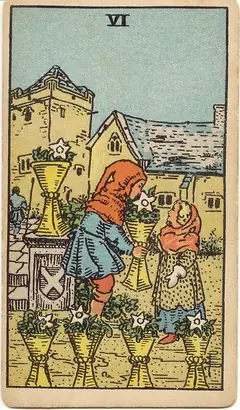

Six of Cups at a glance
| Upright | Nostalgia, childhood memories, reunion, innocence, generosity |
| Reversed | Stuck in the past, rose-tinted memory, unresolved history, letting go |
| Element | Water |
| Astrology | Sun in Scorpio (second decan of Scorpio, Golden Dawn attribution) |
| Numerology | 6: harmony, care and responsibility (see life path 6) |
| Yes or no | Yes, gently, for matters of kindness, family and reconnecting |
Upright: a return, a smell, a song
Upright, the card concerns recollection and kindness. It can refer to a real return, such as a visit to a childhood place or meeting an old friend, or to a mood of nostalgia in which the present is warmed by what came before.
The boy gives without expecting anything, so the card also points to simple, unforced acts of care. A further reading is play: bringing some lightness back into routines that have become too serious. People sometimes draw it when they want to remember what they loved before life got busy.
Reversed: when memory turns into a trap
Reversed, the past can hold on too tightly. The card may describe someone who lives more in memory than in the present, compares everything with an idealised earlier time, or is held back by old hurts never resolved. It can also describe a reunion that disappoints because people have changed.
Read gently, it asks whether you are remembering accurately. Memory softens edges, so look at the past as it was, with good and difficult parts, and decide what to bring forward. If past events still cause distress, a counsellor can help more than any card.
Love and family: familiar warmth and old patterns
Upright, the card points to comfortable, familiar love: a relationship with a long shared history, a reunion with a former partner or friend, or a new love that feels like coming home. It also fits family affection and small rituals. For singles it may suggest that someone from your past or existing circle deserves a second look, which is something to reflect on, not a forecast.
Reversed, it may suggest lingering on an ex, comparing a partner with the past, or acting out childhood patterns in adult relationships. Its backward glance is gentler than the raw grief of the Five of Cups, the card before it.
Work and money: old colleagues, older fields
At work the Six of Cups suggests supportive, familiar workplaces, mentoring, working with people you have known a long time, or a return to an earlier field or employer. It also fits roles around children, education, heritage or care. Reversed, it may mean longing for how a company used to be, or resisting change. In traditional readings it can touch on inheritance and family matters. It is not a financial prediction, so take professional advice on any decision.
As feelings, and as advice: do something you loved at ten
As feelings, it stands for tenderness, sentimental attachment and a wish for security. As advice, it suggests reaching out to someone you have lost touch with, doing something kind for no reason, or spending an afternoon on something that delighted you as a child. Carry the lessons of the past without being governed by them.
Its plain generosity also contrasts with the swirl of fantasy in the Seven of Cups, the card that follows.