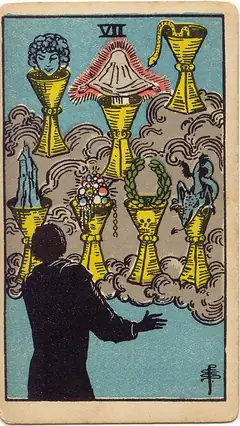

Seven of Cups at a glance
| Upright | Many options, fantasy, daydreaming, wishful thinking, difficulty choosing |
| Reversed | Clarity, decisions, a reality check, committing to one path |
| Element | Water |
| Astrology | Venus in Scorpio (third decan of Scorpio, Golden Dawn attribution) |
| Numerology | 7: reflection, inner search and questioning (see life path 7) |
| Yes or no | Leans no or not yet, since the situation lacks clarity |
Upright: plenty on offer, no direction
Upright, the card describes abundance without a heading. There are many offers, ideas or daydreams, and it is hard to tell which are solid. Imagination is a gift, but the card gently notes that fantasy alone is a poor basis for a decision.
It often appears when options are compared by what you hope for rather than what is actually on offer, or when someone imagines ten future lives and lives none of them. The remedy is unglamorous. Get specific: which cup would you reach for if you had to choose today, and what is the first practical step?
Reversed: the clouds clear
Reversed, the card often marks the moment a fantasy is seen through, a decision is made, or one direction is chosen. It can be a healthy disillusionment, where a tempting option turns out smaller than it looked and energy is freed for something real.
It can also be uncomfortable. Letting go of a fantasy is a small loss, and some people swing into cynicism. Keep the imagination, but give it a practical outlet. If choices feel overwhelming or daydreaming is crowding out daily life, a counsellor or doctor can help.
Love: falling for potential instead of the person
Upright, the card can describe idealisation: loving what someone might become, juggling several possible romances, or dreaming of a perfect partner while overlooking the present. It asks whether a feeling rests on knowing someone or imagining them. In an existing relationship it may show a wandering mind or unrealistic expectations.
Reversed, it suggests seeing clearly, either choosing one person or recognising that a dream person was a projection. That can be healing. The opposite of fantasy appears in the Two of Cups, where two people really meet.
Work and money: many ideas, little focus
At work the card suggests a wealth of ideas and little focus: several possible careers, projects started and not finished, or offers that look better than they are. It calls for checking the practical details. Reversed, it marks the point where options narrow and commitment starts. On money it cautions against schemes that sound too good to be true and favours checking facts. This is reflection, not financial advice, so consult a professional for any real decision.
As feelings, and as advice: write the options down
As feelings, it describes restlessness, longing and a dreamy mood, or difficulty deciding. As advice, it says to list the options, test each against reality and ask trusted people what they see. Then choose one small experiment and try it.
The suit moves on to a far more decisive step in the Eight of Cups, where the figure actually walks away.