By Niket JainPublished Updated Drafted with AI tools under Niket Jain's direction, checked before publishing. How we write
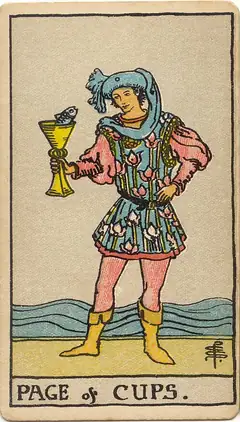
Page of Cups in the 1909 Rider-Waite-Smith deck, drawn by Pamela Colman Smith. Public domain; scan from Wikimedia Commons.
In short
The Page of Cups is the youngest and most playful of the Cups court: a young person stands by the sea while a fish pops out of a cup to say hello. It is the tarot’s image of a surprise from the imagination, a message, idea or feeling that arrives gently and asks to be taken seriously without being taken too heavily.
In the Rider-Waite-Smith deck, illustrated by Pamela Colman Smith, a young person stands on a beach with the sea behind them, holding a golden cup. A small fish rises from the cup and looks up at the Page, who tilts their head towards it with a mild, slightly amused look, not at all alarmed.
The clothing is distinctive: a tunic patterned with blue flowers, which look like lotuses or water lilies, and a large blue hat with a scarf trailing behind. A fish in a cup is an unusual image, and it is usually read as the subconscious, or a creative idea, surfacing into view. The sea is calm and the sky pale, so the scene is gentle and unthreatening.
Saying yes to the odd little idea: the upright Page
Upright, the Page of Cups is about fresh emotional or creative energy. It often signals a message: an invitation, a love note, good news, the kind that makes you smile. As a person, it can describe a young or young-hearted individual who is sensitive, imaginative and kind, perhaps an artist or dreamer.
It is also a card of receptivity. The Page is willing to be surprised by the fish and does not dismiss it as silly. That invites you to listen to intuition, daydreams and the small odd ideas that drift in, and to try them in a low-stakes way. A sketchbook, a playlist, a free afternoon and a phone call to a friend are very Page of Cups activities.
When the fish goes quiet: reversed
Reversed, the card can point to emotional immaturity, such as sulking, oversensitivity, or reacting to small slights as though they were huge. It may describe a creative block, where ideas feel stuck, or messages that are delayed, unclear or disappointing. In some readings it describes escapism: using daydreams to avoid practical tasks.
Read kindly, it is a reminder that feelings need looking after and expressing, not suppressing. A reversed Page is also a prompt to ask whether you are being honest about what you feel. If oversensitivity or mood swings are causing real difficulty, a doctor or counsellor can help, and no card replaces that.
Giving a small invitation your attention: feelings and advice
As feelings, the card describes tenderness, curiosity and a slightly shy openness. As advice, it suggests saying yes to the small invitation, following an idea just to see where it goes, and treating your inner world as worth listening to. If the card represents a person, expect someone kind who may need patience.
Read the full guide6 more sections: the background, the history and where it comes from
Tarot is a tradition of interpretation and a tool for reflection, not a way to predict events. The Page can be read as a person in your life, as a message, or as a young, curious and tender part of yourself. You are the best judge of which reading fits your question.
Page of Cups at a glance
Upright
Curiosity, a pleasant message or invitation, creative inspiration, openness, sensitivity
Reversed
Emotional immaturity, creative block, oversensitivity, mixed or delayed messages
Element
Earth of Water (Golden Dawn court system)
Astrology
No single sign: in the Golden Dawn system the Pages rule a quarter of the sky rather than a stretch of the zodiac, though the card is often linked loosely with the water signs Cancer, Scorpio and Pisces
Numerology
None: court cards are not numbered in the deck
Yes or no
Yes, gently, for questions about creativity, invitations and new feelings
Earth of Water: imagination that lands in the real world
In the Golden Dawn’s scheme the Pages are the Earth part of their suit. Earth of Water can be read as the practical, grounded form of feeling: imagination that arrives in the real world as a note, a sketch or a small kind act.
A tender beginning, or a crush that is more daydream
Upright, the Page of Cups is one of the sweeter love cards. It can describe a new romance with a playful, tender start, a message from someone who likes you, a confession or a gentle overture. As a person it might be someone shy and romantic who shows their feelings through small gestures. The card resembles the openness of the Ace of Cups, only now with a face and a voice.
Reversed, it may suggest mixed signals, moodiness, immaturity in a partner or in yourself, or a crush that is more daydream than reality. Checking in directly with the other person is often more useful than trying to decode signals. The card is not a reason to stay in or leave a relationship.
Where the Page leads: on to the Knight
The Page begins the Cups court, and the Knight of Cups is the next step, who carries the same feeling out into the world on a journey. Where the Page is surprised by the feeling, the Knight acts on it.
Creative fields and half-formed proposals
At work the Page of Cups is a friendly card for creative industries, training and new ideas. It might point to a brainstorming session, a pleasant email, a job offer that arrives on friendly terms, or a young colleague with a fresh perspective. It supports a playful, exploratory approach. Reversed, it can describe creative block, a proposal that feels half-formed or lack of discipline. On money, the card has little to say directly except to keep daydreams separate from plans. This is reflection, and not financial advice.
A question about the idea you dismissed
What small, odd idea or feeling has been surfacing lately that you have dismissed? What would happen if you gave it ten minutes of real attention?
Frequently asked questions
↳ What does the fish in the Page of Cups mean?
The fish rising from the cup is usually read as a message from the subconscious, a creative idea or a feeling coming to the surface. The Page's calm response shows the attitude the card recommends: curious and unafraid.
↳ Does the Page of Cups mean a message is coming?
Traditionally the Page is a messenger, so many readers take it as a sign of news or an invitation, often an emotional or pleasant one. It can equally be an inner message, so treat it as a possibility and not a certainty.
↳ What does the Page of Cups mean in love?
It usually signals a tender beginning, a sweet gesture or a sincere confession. Reversed, it can suggest mixed signals or emotional immaturity, in which case direct conversation helps.
↳ What does the Page of Cups mean in a yes or no reading?
It leans towards yes for creative, social and romantic questions, and suggests the answer will come gently. Reversed, it suggests waiting, since feelings or messages are unclear.
↳ Is the Page of Cups a person?
It can be. Readers often see it as a young or youthful, sensitive, creative person. It can equally stand for an aspect of yourself or an energy in the situation, and the question you asked should guide you.