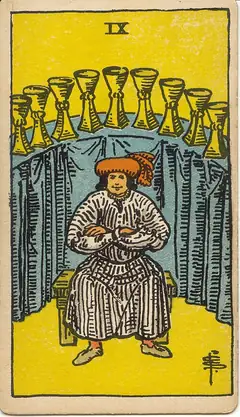

Arms folded, nine cups behind: reading the scene
In the Rider-Waite-Smith deck, illustrated by Pamela Colman Smith, a man sits on a wooden bench with his arms folded across his chest. He wears a red cap and a rich orange-yellow tunic and has a slight smile, relaxed and at ease. Behind him, on a curved table covered in blue cloth, stand nine golden cups in an arc, against a plain yellow background.
The folded arms can be read two ways. Positively they mean contentment and self-possession. A more cautious reading treats them as guardedness: he is comfortable, but alone, with nobody to share the display. The cups are shown and not drunk from, which suggests a card about having and appreciating, not consuming. The setting is a moment of quiet satisfaction, not a party.
When having more does not feel like enough: reversed
Reversed, the satisfaction becomes thin. The card can describe someone who has most of what they wanted but still feels empty, or who uses indulgence such as food, shopping or drink to fill a gap. It can also describe smugness, where pride in what you have tips into looking down on others, or a wish that arrives and turns out to be disappointing.
Gently read, it suggests looking beneath the surface. Why does having more not feel like enough? The answer is often connection, meaning or rest, not more stuff. If indulgence has started to feel compulsive or damaging, speak to a doctor or counsellor, because a card can point to a pattern but cannot treat it.
Recognition at work, and spending to cope
At work the Nine of Cups marks satisfaction: a job you enjoy, recognition, a target reached or a business doing well enough to enjoy. It is one of the more positive cards for financial comfort, taken as a general mood and not a forecast. Reversed, it can describe success that feels hollow, complacency, or spending to cope with stress. It is not financial advice, so treat it as a prompt to consider whether what you work for makes you content.