By Niket JainPublished Updated Drafted with AI tools under Niket Jain's direction, checked before publishing. How we write
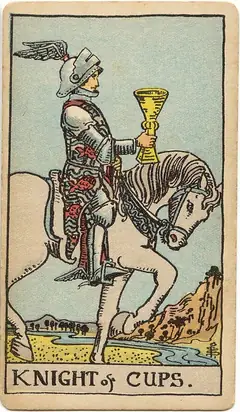
Knight of Cups in the 1909 Rider-Waite-Smith deck, drawn by Pamela Colman Smith. Public domain; scan from Wikimedia Commons.
In short
The Knight of Cups is the tarot’s romantic: a rider who moves at a slow walk and carries a cup out in front of him as if delivering something precious. Where other knights charge, this one presents. His theme is feeling put into action, as an offer, an invitation or a quest led by the heart.
A knight who offers instead of attacking: the picture
In the Rider-Waite-Smith deck, illustrated by Pamela Colman Smith, a knight in armour rides a pale horse in profile, at a slow and steady walk. He holds a golden cup out in front of him with care and ceremony, as if presenting a gift. His helmet has small wings at each side and his boots carry similar wings, the attributes of Mercury, the messenger. His tunic is decorated with fish, tying him to the water of his suit.
Ahead of him a river runs through a rocky landscape with bare mountains in the distance. The horse is calm, not a war charger, and the knight’s face is gentle. There is no battle here. The cup is his only visible burden, and the picture suggests a pilgrimage or courtly quest: someone carrying something beautiful across rough ground.
The charming messenger: what the upright card offers
Upright, the Knight of Cups describes someone or something that arrives with an offer. It could be an invitation, a proposal, a romantic overture or an opportunity that appeals to your values. As a person, the Knight is charming, sensitive, artistic and idealistic, someone who lives by the heart and often inspires others with sincerity.
The card is also about following your own feeling and acting on it, much as a Pisces Moon is said to do. A Knight of Cups moment is when you finally send the message, enter the competition or start the creative project because it matters to you. The card reminds you that kindness and gentleness are valid forms of strength.
Idealising the person, not seeing them: the reversed card
Reversed, the Knight loses his footing. He may describe moodiness, sulking or dramatic swings, a tendency to fall in love with the idea of someone, or promises made with real feeling but not followed through. It can describe escapism, where imagination is used to avoid practical issues.
Gently read, the reversal asks whether charm and intentions are backed by action. If the card represents another person, it may suggest taking time before relying on big declarations. If it represents you, it can be a prompt to ground your ideals in concrete steps. If mood swings are regular and troubling, a doctor or counsellor can help, and tarot cannot replace that.
Creative and caring work, and the danger of overpromising
At work the Knight of Cups suits creative, caring and artistic fields. It can describe a job offer or project that appeals to your values, a colleague who brings enthusiasm, or a pitch that goes well because you believed in it. Reversed, it may suggest overpromising, lack of follow-through, or moving from project to project. On money, feelings can drive choices, so check practicalities before acting on enthusiasm. This is reflection and not financial advice.
Write the letter, then follow up: feelings and advice
As feelings, the card describes romantic longing, sincerity and emotional idealism. As advice, it suggests acting on your heart while keeping an eye on the ground in front of you. Write the letter, make the offer, present the idea, then follow up with the small concrete steps that make it real.
Read the full guide5 more sections: the background, the history and where it comes from
Tarot is a tradition of interpretation and a tool for reflection, not a way to predict events. The Knight can stand for a person, a proposal, or a mood in yourself that wants to follow an ideal.
Knight of Cups at a glance
Upright
Romance, charm, an offer or invitation, idealism, following your heart
Pisces (Golden Dawn arc: 20 degrees Aquarius to 20 degrees Pisces)
Numerology
None: court cards are not numbered in the deck
Yes or no
Yes, with a romantic or idealistic flavour; check the practical details
Fire of Water: passion with somewhere to go
In the Golden Dawn system the Knight is Fire of Water, which describes feeling that has energy and movement: the passion to act on a dream. Court card attributions vary between authors, and this site follows the Golden Dawn scheme.
Between the Page and the Queen
The Knight is the second step in the Cups court. The Page, the youngest, receives the surprise; the Knight takes the feeling out into the world on a journey. The next figure in the suit, the Queen of Cups, shows that same sensitivity at a deeper and steadier level, no longer travelling but settled beside the water.
Courtship, gestures and the first-meeting glow
Upright, this is one of the great romantic cards. It can describe courtship with letters, flowers and thoughtful effort, or a partner who is affectionate and expressive. For singles it may suggest that a romantic prospect appears, or that you are ready to put your heart forward. In an existing relationship it invites you to bring back the romance with a small, deliberate gesture. Its mood echoes the mutual pledge of the Two of Cups.
Reversed, it may point to idealising a partner, inconsistency between words and actions, or a pattern of passionate beginnings that fade. It asks you to look at behaviour over time, not just the charm of a first meeting. If you feel pressured or unsafe in a relationship, seek real support.
A question about what you could hand over
What are you carrying that you would like to offer someone, and what has stopped you from handing it over? Where could a little more follow-through turn a beautiful intention into something real?
Frequently asked questions
↳ Is the Knight of Cups a good card for love?
Generally yes. It stands for romance, courtship and heartfelt gestures. Its caution is that idealism can run ahead of reality, so it is worth watching whether actions match feelings over time.
↳ What does the Knight of Cups mean when it represents a person?
Readers usually describe a charming, artistic, romantic and sensitive person who follows their heart. It may be someone who makes offers or who is slightly dreamy. It is an interpretation and not a verdict on anyone's character.
↳ What do the wings on the Knight of Cups mean?
The wings on his helmet and boots recall Mercury, messenger of the gods. They suggest that he carries a message or offer, and that he moves with grace and inspiration more than force.
↳ What does the Knight of Cups mean in a yes or no reading?
Upright it leans towards yes, particularly for romantic, creative and idealistic questions. Reversed it suggests caution about promises or mood-driven choices.
↳ What does the Knight of Cups reversed mean?
It usually points to moodiness, unrealistic expectations or promises that are not followed through. It is an invitation to ground feelings in action, not a sign that romance is impossible.