
A throne on rough water: what the picture shows
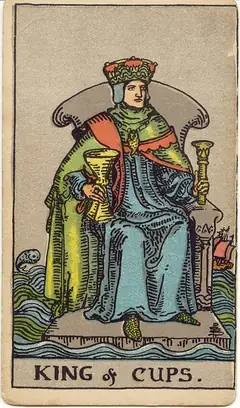
In the Rider-Waite-Smith deck, illustrated by Pamela Colman Smith, a king sits on a stone throne that floats on a choppy sea. Waves rise around him. A fish leaps from the water on one side, and a ship sails in the distance on the other. He wears a crown, blue and orange robes and a fish-shaped pendant on a chain. In one hand he holds a golden cup, and in the other a short sceptre.
The details are well chosen. The restless sea stands for emotion, and the throne sits on it without being overthrown. The leaping fish is commonly read as the creative or subconscious life of the deep brought into the open, and the ship as the practical, human capacity to navigate the same waters. The pendant repeats the fish, like a badge of kinship with the water. He holds the cup loosely, as if he has no need to grip it. Among the four Cups court figures he is the only one seated out on the sea and not at its edge, which readers take to mean he has passed through the feeling and stands on its far side.
Mastery without numbness: the upright card
Upright, the King of Cups stands for emotional mastery. This does not mean having no feelings; the sea is still stormy. It means he has learned how to sit on it. He is diplomatic, patient and generous, the sort of person people turn to for a steady view in a crisis.
As a quality, the card invites you to treat emotions as a source of wisdom and not as something to suppress or to be ruled by. It encourages calm communication, compassion in leadership and readiness to listen before answering. A King of Cups moment might be a conversation in which you keep your voice level, a decision made with care for everyone involved, or a long-held feeling finally put into words.
Calm face, hidden storm: the reversed King
Reversed, the balance breaks in one of two directions. The King may become cold, shutting feelings down behind a calm face, or volatile, with moods that swing and affect people around him. In the sharpest readings he is manipulative, using charm or guilt to steer people. As a description of a person, this is a caution and not a fixed judgement.
Read gently, the reversed card is about a gap between what is felt and what is shown. The work it suggests is not to become harder or softer but more honest: naming what you feel, then choosing a response. If emotions feel unmanageable, or if you are being manipulated by someone, seek support from a counsellor or a trusted person. No card replaces that.
A steady partner, or a partner who avoids the hard talk
Upright, the King of Cups is a steady, caring partner: warm, considerate and able to talk through conflict without drama. For singles, it may describe a mature relationship in which kindness matters as much as attraction. It also suggests that you can be the steady presence in a partnership.
Reversed, it may point to emotional distance, a partner who avoids difficult conversations, or moods that affect the household. It might also indicate passive manipulation or mixed signals. If a relationship feels controlling or unsafe, that calls for practical support.
Leading with compassion at work
At work the King of Cups describes compassionate leadership: a manager, mentor or adviser who is calm under pressure and treats people fairly. It suits counselling, healthcare, teaching, the arts and mediation. Reversed, it may describe a boss who hides their emotions or lets them leak, or a workplace where feelings are ignored. On money, the card favours steady, considered decisions over emotional ones. This is reflection and not financial advice, so consult a qualified adviser for any real decision.
Pausing before you react: feelings and advice
As feelings, the card describes calm, care and emotional steadiness. As advice, it suggests pausing before you react, listening first and answering with kindness and clarity. Keep the sea in view, but do not let it decide for you.