By Niket JainPublished Updated Drafted with AI tools under Niket Jain's direction, checked before publishing. How we write
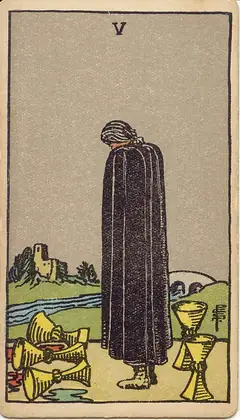
Five of Cups in the 1909 Rider-Waite-Smith deck, drawn by Pamela Colman Smith. Public domain; scan from Wikimedia Commons.
In short
The Five of Cups is the card of grief and regret, shown through a figure who stares at three spilled cups and has not yet noticed the two that are still standing. It is tender more than frightening: it admits that loss hurts and that attention tends to go where the hurt is.
Grief, regret, disappointment, dwelling on what has been lost
Reversed
Acceptance, forgiveness, healing, turning towards what remains
Element
Water
Astrology
Mars in Scorpio (first decan of Scorpio, Golden Dawn attribution)
Numerology
5: change, disruption and adjustment (see life path 5)
Yes or no
Leans no for now; the card asks you to look at your grief before deciding
What the upright Five of Cups says about grief
Upright, the card is about grief and regret. It might refer to an ending, a mistake, a betrayal or a hope that did not work out. It gives permission to feel sad: the figure does not hurry, and the picture does not scold.
It also points out a pattern. When something hurts, it is easy to see only the spill and forget what remains, whether people, resources or possibilities. The card does not say the loss is small. It says that something else may be in your life that cannot yet be seen because your gaze is fixed on what went wrong. Mourning is a proper process, and the card is best read as a nudge to let it happen and, in time, to lift your head.
When the figure turns: the reversed card
Reversed, the figure turns. The card suggests acceptance, forgiveness and a first look at the standing cups. It often marks the stage where grief is no longer the whole picture, where someone starts to cross the bridge, to reconnect with friends, or to forgive themselves or another person.
It can also signal the opposite danger: bottling grief up, refusing to admit the loss, or hurrying towards forgiveness before it has been felt. If grief, regret or sadness is heavy or long-lasting, it is worth speaking to a doctor, counsellor or a support service. Tarot can offer a moment of reflection, but it cannot replace care.
Heartbreak, nostalgia and repair
Upright, the card often describes heartbreak, a relationship that ended or changed, or sadness about a choice made. It can also describe nostalgia for an earlier stage of a relationship, or disappointment that a partner did not turn out as hoped. The image is one of feeling the loss properly before deciding what to do next.
Reversed, it suggests recovery: forgiving an ex, making peace with a past relationship or becoming open to new connection. For a couple it can mean repairing after an argument by acknowledging what hurt. You may find it helpful to compare it with the hopeful, shared gesture of the Two of Cups. The card describes a feeling; it is not a reason to stay in or leave anything.
Setbacks at work, and regret over money
At work, the card may describe disappointment over a missed promotion, a project that fell through or a colleague leaving. Upright, it asks you to acknowledge the setback and not pretend it does not sting. Reversed, it often suggests learning from the failure and moving on with new plans. In money matters it may refer to regret about a past decision. It is not a forecast of loss and not financial advice, so get proper guidance for any major decision.
Naming what you grieve: the card as feelings and as advice
As feelings, the card describes sorrow, regret or a sense of loss, in you or in the situation. As advice, it suggests naming what you grieve, allowing time, and then asking what remains. Talk to someone you trust. Notice the cups still standing: a friend who called, a skill you still have, a morning that went well. This is not about forcing positivity, only widening the view.
Read the full guide4 more sections: the background, the history and where it comes from
It is not a prediction of loss. Tarot is a tradition of interpretation and a tool for reflection, and this card is usually read as a description of a mood or a way of looking. Its useful question is simple: what is still standing, and when might you be ready to turn round?
Three spilled cups, two still full: reading the picture
In the Rider-Waite-Smith deck, illustrated by Pamela Colman Smith, a figure stands wrapped in a dark hooded cloak, face turned down and away from the viewer. Three cups lie in front of the figure, spilled onto the ground. The spilled liquid is commonly read as wine or as tears, and the cloak as mourning.
Behind the figure, out of the line of sight, stand two more cups, upright. That is the essential design of the card: the person is not without resources, only facing the wrong way. A river runs through the scene, usually read as emotion that keeps moving, and a bridge crosses it towards a distant house or castle, which suggests a way from this place to somewhere sheltered. The sky is grey and the ground is bare, so the mood is sombre without being hopeless.
Why Mars in Scorpio suits a card about raw feeling
The Golden Dawn attributes the card to Mars in Scorpio. Mars is the energetic, forceful planet, and Scorpio is a fixed water sign of depth and intensity. Readers who use the attribution link the pairing with strong feeling that does not let go easily: anger turned inward, rawness, and the need to go through an emotion and not around it. If you do not use astrology with tarot, the picture stands on its own.
Where the card sits: the fifth cup, after withdrawal and before memory
The Five is the midpoint of the suit’s run from Ace to Ten, and the first cup card in which something has clearly gone wrong. It follows the withdrawn boredom of the Four of Cups, where a cup was offered and ignored, and it leads towards the wistful backward glance of the Six of Cups. In that sequence the Five is the moment feeling turns to loss, and also the moment the suit begins to turn back towards recovery.
A question about what you are mourning
What are you mourning, and what have you allowed yourself to feel about it so far? If you turned around slowly, what is one thing behind you that is still whole?
Frequently asked questions
↳ Is the Five of Cups a bad card?
It is a sad card, but not a warning of disaster. It describes grief and regret that already exist, and it points gently to what remains. Many readers find it one of the most compassionate cards in the deck.
↳ What do the two standing cups in the Five of Cups mean?
They represent what is still available: relationships, resources or opportunities that the grieving figure has not yet turned to see. The image suggests that loss and remaining good can exist at the same time.
↳ What does the Five of Cups mean in love?
It often refers to heartbreak, regret or disappointment in a relationship. Reversed, it suggests forgiveness and recovery. It describes a feeling and does not say a relationship will end.
↳ What does the Five of Cups mean in a yes or no reading?
It generally leans towards no, or towards not yet, because the emotional situation needs attention first. Reversed, it softens towards a cautious yes as healing begins.
↳ What does the bridge in the Five of Cups stand for?
The bridge over the river leads to a building in the distance, which readers take as a path towards shelter and recovery. It suggests that a way forward exists even while the figure is looking the other way.