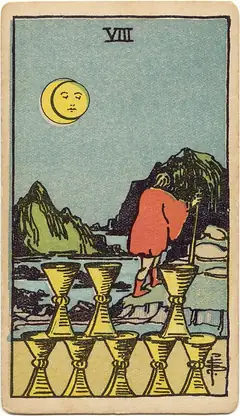

Card 8 of Cups, in brief
| Upright | Walking away, letting go, searching for something deeper, outgrowing a situation |
| Reversed | Fear of leaving, staying out of habit, aimless drifting, coming back |
| Element | Water |
| Astrology | Saturn in Pisces (first decan of Pisces, Golden Dawn attribution) |
| Numerology | 8: power, endings and cycles (see life path 8) |
| Yes or no | Leans no to staying as things are; often yes to making a change |
Upright: nothing is wrong, and something is missing
Upright, the Eight of Cups describes a decision to go. The reasons are usually undramatic: nothing is wrong, exactly, but something is missing. A person might outgrow a job, a place or a role and feel that staying would mean settling. The card is honest that this involves loss, since those eight cups took effort to build.
It can also stand for a search, a spiritual or personal quest, or a need for solitude. The mountains ahead are not pretty or sheltered, and the card does not promise that what lies beyond is easier. Leaving can be an act of self-respect, and the best questions are practical: what am I leaving, what am I looking for, and am I moving towards something or only away?
Reversed: hesitating, drifting or doubling back
Reversed, the traveller hesitates or turns back. The card can describe staying in a situation long after it stopped satisfying, out of fear, habit or sunk cost. It can describe walking away without a plan, drifting from one thing to another hoping the emptiness will pass, or returning to something you left to see if it has changed.
None of this is failure. Sometimes the reversed card says that the time to leave has not yet come and that patience or preparation is needed. If the emptiness is persistent and heavy and follows you from place to place, it is worth talking to a doctor or counsellor, since a change of scene does not always help with low mood.
Love: leaving the comfortable and hollow
Upright, the card can describe ending a relationship that is stable but unfulfilling, or stepping away from a dynamic that is familiar but hollow. It might also describe someone who needs to go inward and rediscover themselves before being ready for partnership. For a couple, it may invite an honest conversation about what feels missing, before anyone leaves. It does not say that relationships always end, and it never decides for you whether to stay.
Reversed, it suggests difficulty letting go, on and off patterns, or staying from fear of being alone, or a person who left and now wonders whether to return. If a relationship is harmful, that is a matter for real support. The Five of Cups can be seen as the grief that a departure leaves behind, and the Two of Cups as its opposite, a bond both people are still choosing.
Work and money: change with a plan
At work, upright, the card often appears when a person is ready to change careers, leave a stable job for something more meaningful, or step away from a project that no longer matters. It values fulfilment alongside security. Reversed, it may suggest staying in a dull role from fear, or job-hopping without direction. For money, it calls for careful preparation before a large change. This is reflection and not financial advice, so seek proper guidance first.
Feelings and advice: plan the exit, and allow the grief
As feelings, the card suggests a quiet dissatisfaction, a need for something more and a readiness to move. As advice, it says to take the feeling seriously but plan carefully: savings, support, a first destination. It is fine to grieve what you leave. You might also ask whether the answer is to go or to change how you stay. In the suit’s sequence, the next card is the Nine of Cups, its most contented point.